Introduction
- Pyrimidine biosynthesis is the metabolic pathway responsible for the formation of pyrimidine nucleotides required for DNA and RNA synthesis.
- The three major pyrimidine bases are cytosine (C), thymine (T), and uracil (U), which are essential components of nucleic acids.
- Unlike purine biosynthesis, the pyrimidine ring is synthesized first and then attached to ribose phosphate (PRPP) to form nucleotides.
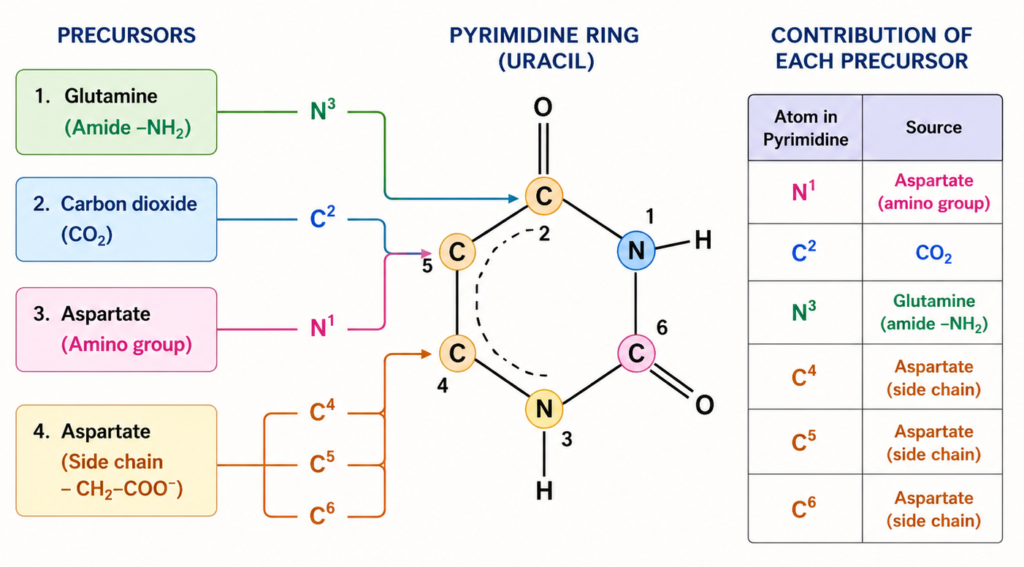
- The pathway utilizes simple precursors such as glutamine, aspartate, carbon dioxide (CO₂), ATP, and PRPP to synthesize uridine monophosphate (UMP), the first pyrimidine nucleotide.
- Pyrimidine nucleotides are essential for DNA replication, RNA transcription, cell growth, tissue repair, glycogen synthesis, and phospholipid metabolism.
Structure
Pyrimidines are single six-membered heterocyclic nitrogen-containing rings.
They contain two nitrogen atoms located at positions 1 and 3.
Three Major Pyrimidines
| Base | Present In | Sugar |
|---|---|---|
| Cytosine | DNA & RNA | Ribose/Deoxyribose |
| Thymine | DNA only | Deoxyribose |
| Uracil | RNA only | Ribose |
Functions of Pyrimidine Nucleotides
| Function | Pyrimidine Nucleotide(s) | Description |
|---|---|---|
| DNA Synthesis | dCTP, dTTP | Required for DNA replication and repair by serving as precursors for DNA synthesis. |
| RNA Synthesis | UTP, CTP | Essential for the synthesis of mRNA, tRNA, and rRNA during transcription. |
| Protein Synthesis | UTP, CTP (via RNA) | RNA molecules synthesized from pyrimidine nucleotides are involved in translation and protein synthesis. |
| Glycogen Synthesis | UTP (UDP-glucose) | UTP forms UDP-glucose, the activated glucose donor required for glycogen synthesis. |
| Phospholipid Synthesis | CTP | CTP is required for the synthesis of membrane phospholipids such as phosphatidylcholine and phosphatidylethanolamine. |
| Glycoprotein and Glycolipid Synthesis | UDP-sugars | UDP-galactose, UDP-glucose, and UDP-N-acetylglucosamine participate in the synthesis of glycoproteins, glycolipids, and proteoglycans. |
| Detoxification (Glucuronidation) | UDP-glucuronic acid | Conjugates bilirubin, drugs, hormones, and toxins to increase their water solubility for excretion. |
| Cell Growth and Division | UMP, UDP, UTP, CTP | Provide nucleotides required for DNA replication, RNA synthesis, and normal cell proliferation. |
| Carbohydrate Metabolism | UDP-glucose | Acts as an activated intermediate in glycogen synthesis and carbohydrate metabolism. |
| Clinical Significance | Various pyrimidine nucleotides | Defects in metabolism cause disorders such as orotic aciduria, while drugs like 5-fluorouracil and leflunomide target pyrimidine biosynthesis in cancer and autoimmune diseases. |
Sources of Pyrimidine Nucleotides
| Source | Description |
|---|---|
| De Novo Biosynthesis | Synthesized from simple precursors such as glutamine, aspartate, CO₂, ATP, and PRPP. This is the major source of pyrimidine nucleotides. |
| Salvage Pathway | Recycles free pyrimidine bases and nucleosides (uracil, cytosine, and thymine) to form nucleotides, conserving cellular energy. |
| Dietary Sources | Nucleic acids obtained from foods such as meat, fish, legumes, and yeast provide a minor source of pyrimidine nucleotides after digestion. |
Site of Pyrimidine Biosynthesis
| Organ | Activity |
|---|---|
| Liver | Highest |
| Bone marrow | High |
| Intestinal mucosa | High |
| Rapidly dividing cells | High |
Cellular location
- Cytoplasm
- One mitochondrial step
Biosynthesis
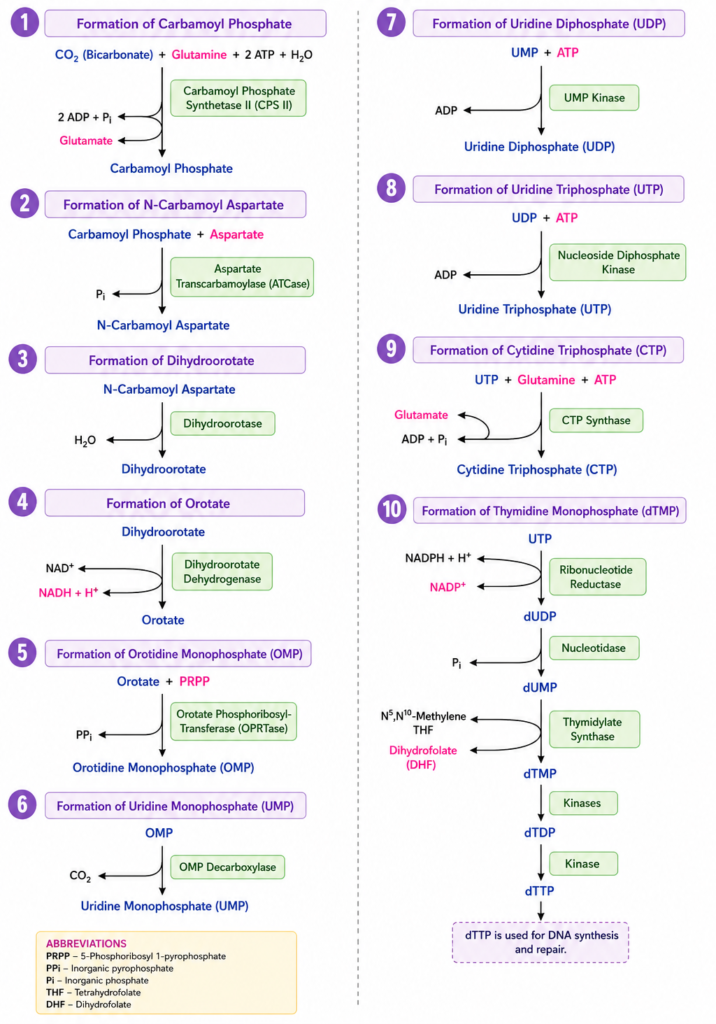
- The de novo biosynthesis of pyrimidine nucleotides is the metabolic pathway by which cells synthesize pyrimidine nucleotides from simple precursor molecules.
- Unlike purine biosynthesis, the pyrimidine ring is synthesized first and then attached to phosphoribosyl pyrophosphate (PRPP).
- The first pyrimidine nucleotide formed is uridine monophosphate (UMP), which serves as the precursor for UDP, UTP, CTP, and dTMP.
Regulation of Pyrimidine Biosynthesis
- The biosynthesis of pyrimidine nucleotides is tightly regulated to maintain a balanced supply of nucleotides for DNA and RNA synthesis.
- The rate-limiting enzyme, Carbamoyl Phosphate Synthetase II (CPS-II), is the primary regulatory point of the pathway.
| Regulator | Target Enzyme | Effect | Significance |
|---|---|---|---|
| UTP | Carbamoyl Phosphate Synthetase II (CPS-II) | Inhibits | Feedback inhibition prevents excessive pyrimidine synthesis. |
| PRPP (Phosphoribosyl Pyrophosphate) | Carbamoyl Phosphate Synthetase II (CPS-II) | Activates | Stimulates pyrimidine synthesis when ribose-5-phosphate is abundant. |
| ATP | Carbamoyl Phosphate Synthetase II (CPS-II) | Activates | Coordinates pyrimidine synthesis with purine availability, maintaining balanced nucleotide pools. |
| CTP | CTP Synthetase | Feedback Inhibition | Prevents excessive conversion of UTP to CTP. |
Salvage Pathway
- The salvage pathway is an energy-efficient mechanism in which free pyrimidine bases and nucleosides released during the degradation of DNA and RNA are recycled to synthesize pyrimidine nucleotides.
- This pathway conserves cellular energy by avoiding the need for de novo synthesis.
Importance of the Salvage Pathway
- Recycles pyrimidine bases and nucleosides.
- Conserves cellular energy (ATP).
- Maintains an adequate supply of pyrimidine nucleotides.
- Supports DNA and RNA synthesis, especially in rapidly dividing cells.
- Reduces the need for de novo pyrimidine biosynthesis.
Salvage Reactions
| Pyrimidine Base/Nucleoside | Enzyme | Product Formed |
|---|---|---|
| Uracil + PRPP | Uracil Phosphoribosyltransferase (UPRTase)* | UMP |
| Uridine + ATP | Uridine Kinase (UK) | UMP |
| Cytidine + ATP | Cytidine Kinase (CK) | CMP |
| Thymidine + ATP | Thymidine Kinase (TK) | TMP |
Note: In humans, uridine kinase, cytidine kinase, and thymidine kinase are the major salvage enzymes. Uracil phosphoribosyltransferase (UPRTase) is prominent in microorganisms and is not a major salvage enzyme in humans.
Pyrimidine Catabolism
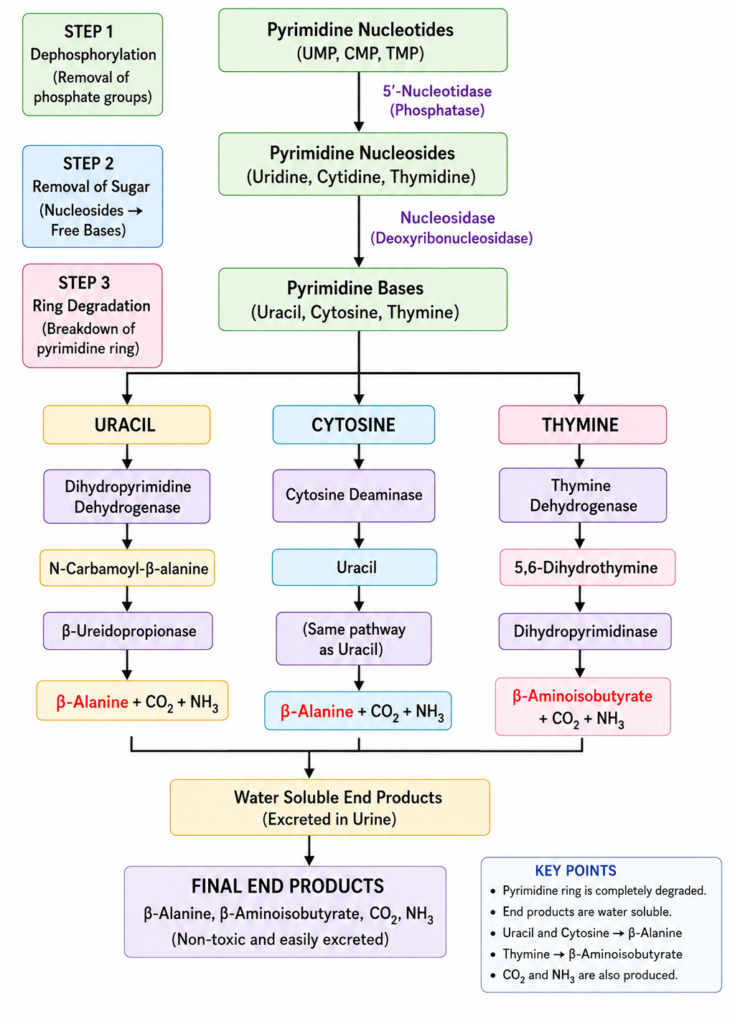
Clinical Disorders
1. Orotic Aciduria
- Orotic aciduria is a rare autosomal recessive metabolic disorder caused by a deficiency of the bifunctional enzyme UMP synthase (which possesses orotate phosphoribosyltransferase and OMP decarboxylase activities).
- This enzyme defect blocks the conversion of orotic acid to uridine monophosphate (UMP), resulting in the accumulation of orotic acid in urine and impaired pyrimidine nucleotide synthesis.
Causes
- Deficiency of UMP synthase (OPRTase and OMP decarboxylase)
- Defective de novo pyrimidine biosynthesis
Clinical Features
- Megaloblastic anemia (unresponsive to vitamin B₁₂ and folic acid)
- Growth retardation and failure to thrive
- Developmental delay
- Increased urinary excretion of orotic acid
- Normal blood ammonia levels (helps differentiate it from urea cycle disorders)
Diagnosis
- Elevated urinary orotic acid
- Decreased UMP synthesis
- Genetic testing for UMP synthase deficiency
Treatment
- Oral uridine or uridine triacetate supplementation bypasses the metabolic block, restores pyrimidine nucleotide synthesis, reduces orotic acid excretion, and improves anemia and growth.
2. Dihydropyrimidine Dehydrogenase Deficiency
- Dihydropyrimidine Dehydrogenase (DPD) deficiency is a rare inherited autosomal recessive disorder caused by mutations in the DPYD gene, leading to reduced or absent activity of the enzyme dihydropyrimidine dehydrogenase (DPD).
- This enzyme catalyzes the first and rate-limiting step of pyrimidine catabolism, converting uracil and thymine into their respective dihydro forms.
- Deficiency results in the accumulation of pyrimidine bases and markedly increases the risk of severe toxicity to the anticancer drug 5-fluorouracil (5-FU) and its prodrug capecitabine.
Causes
- Mutations in the DPYD gene
- Partial or complete deficiency of DPD enzyme
Clinical Features
- Developmental delay
- Intellectual disability
- Seizures
- Hypotonia (reduced muscle tone)
- Increased levels of uracil and thymine in blood and urine
- Severe or life-threatening toxicity after treatment with 5-fluorouracil (5-FU) or capecitabine
Diagnosis
- Elevated plasma or urinary uracil levels
- Measurement of DPD enzyme activity
- DPYD genetic testing
Treatment
- Avoid 5-fluorouracil (5-FU) and capecitabine in affected individuals.
- Supportive management for neurological symptoms.
- Genetic counseling for affected families.
3. Cancer
- Cancer cells divide rapidly and require a continuous supply of pyrimidine nucleotides for DNA replication and RNA synthesis.
- To meet this increased demand, cancer cells exhibit enhanced de novo pyrimidine biosynthesis.
- Therefore, several anticancer drugs target key enzymes of this pathway to inhibit nucleotide production and prevent tumor cell proliferation.
Mechanism
- Rapidly dividing cancer cells have an increased requirement for pyrimidine nucleotides.
- Inhibition of pyrimidine biosynthesis blocks DNA and RNA synthesis, thereby suppressing cancer cell growth.
Drugs Targeting Pyrimidine Biosynthesis
| Drug | Target Enzyme | Clinical Use |
|---|---|---|
| 5-Fluorouracil (5-FU) | Thymidylate Synthase | Colorectal, breast, gastric, and head & neck cancers |
| Capecitabine | Converted to 5-FU in the body | Colorectal and breast cancers |
| Methotrexate | Dihydrofolate Reductase (DHFR) | Leukemia, lymphoma, and other malignancies |
| Leflunomide | Dihydroorotate Dehydrogenase (DHODH) | Mainly rheumatoid arthritis; also studied as an anticancer agent |
Clinical Significance
- Pyrimidine biosynthesis is an important target in modern cancer chemotherapy.
- Inhibiting nucleotide synthesis prevents DNA replication and slows tumor growth.
- Patients with Dihydropyrimidine Dehydrogenase (DPD) deficiency may develop severe toxicity to 5-fluorouracil (5-FU) and capecitabine, making DPD testing important before treatment.
4. Reye’s Syndrome
- Reye’s syndrome is a rare but serious disorder characterized by acute encephalopathy and fatty degeneration of the liver.
- It most commonly affects children and adolescents recovering from viral infections such as influenza or chickenpox (varicella) and is strongly associated with the use of aspirin (salicylates) during these illnesses.
- The syndrome results from mitochondrial dysfunction, leading to impaired fatty acid oxidation and elevated blood ammonia levels.
Causes
- Aspirin use during viral infections (influenza, chickenpox)
- Mitochondrial dysfunction causing impaired fatty acid oxidation
Clinical Features
- Persistent vomiting
- Lethargy and confusion
- Irritability
- Seizures
- Coma (in severe cases)
- Hepatomegaly with fatty liver
Laboratory Findings
- Elevated serum ammonia (hyperammonemia)
- Increased AST and ALT levels
- Hypoglycemia
- Prolonged prothrombin time (PT)
- Fatty infiltration of the liver without significant inflammation
Diagnosis
- Clinical history of recent viral illness and aspirin use
- Liver function tests and serum ammonia
- Neuroimaging to assess cerebral edema
- Liver biopsy (rarely required)
Treatment
- Immediate hospitalization and intensive supportive care
- Control of cerebral edema
- Correction of hypoglycemia and electrolyte imbalance
- Avoid aspirin in children with viral illnesses
Prevention
- Do not administer aspirin to children or adolescents with viral infections.
- Use paracetamol (acetaminophen) or ibuprofen as safer alternatives for fever and pain (unless contraindicated).