Introduction
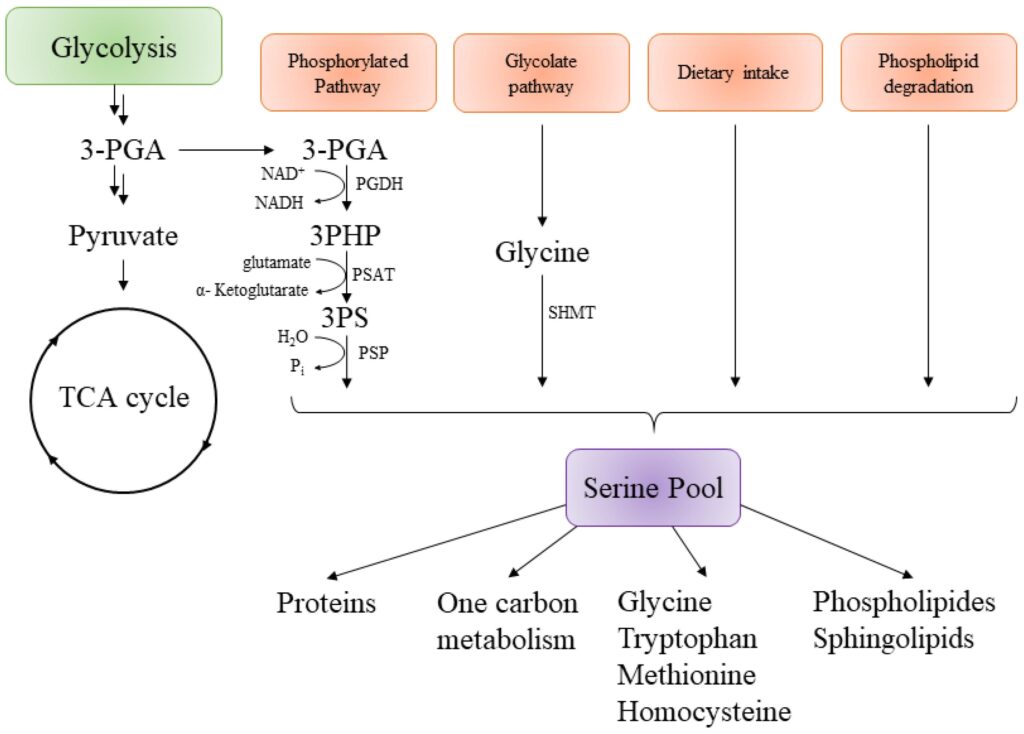
- Serine is a non-essential, glucogenic amino acid synthesized mainly from glucose intermediates.
- It plays a major role in amino acid metabolism, one-carbon metabolism, nucleotide synthesis, phospholipid formation, and neurotransmission.
Serine is closely associated with:
- Glycine metabolism
- Folate metabolism
- Sphingolipid synthesis
- Purine and pyrimidine synthesis
Structure of Serine
| Property | Description |
|---|---|
| Chemical formula | C₃H₇NO₃ |
| Type | Non-essential amino acid |
| Nature | Polar amino acid |
| Side chain | Hydroxymethyl group (-CH₂OH) |
| Major function | One-carbon metabolism |
Biosynthesis of Serine
Serine is synthesized from the glycolytic intermediate 3-phosphoglycerate.
Steps in Serine Synthesis
Step 1: Formation of 3-Phosphohydroxypyruvate
3-Phosphoglycerate → 3-Phosphohydroxypyruvate
Enzyme
-
- 3-Phosphoglycerate dehydrogenase
Step 2: Formation of 3-Phosphoserine
3-Phosphohydroxypyruvate + Glutamate → 3-Phosphoserine
Enzyme
-
- Phosphoserine aminotransferase
Step 3: Formation of Serine
3-Phosphoserine → Serine
Enzyme
-
- Phosphoserine phosphatase
Conversion of Serine to Glycine
Serine is the major precursor of glycine.
Reaction
Serine + THF ⇌ Glycine + N5,N10-methylene THF
Enzyme
- Serine hydroxymethyl transferase
Cofactors
- Pyridoxal phosphate (Vitamin B₆)
- Tetrahydrofolate (THF)
Metabolism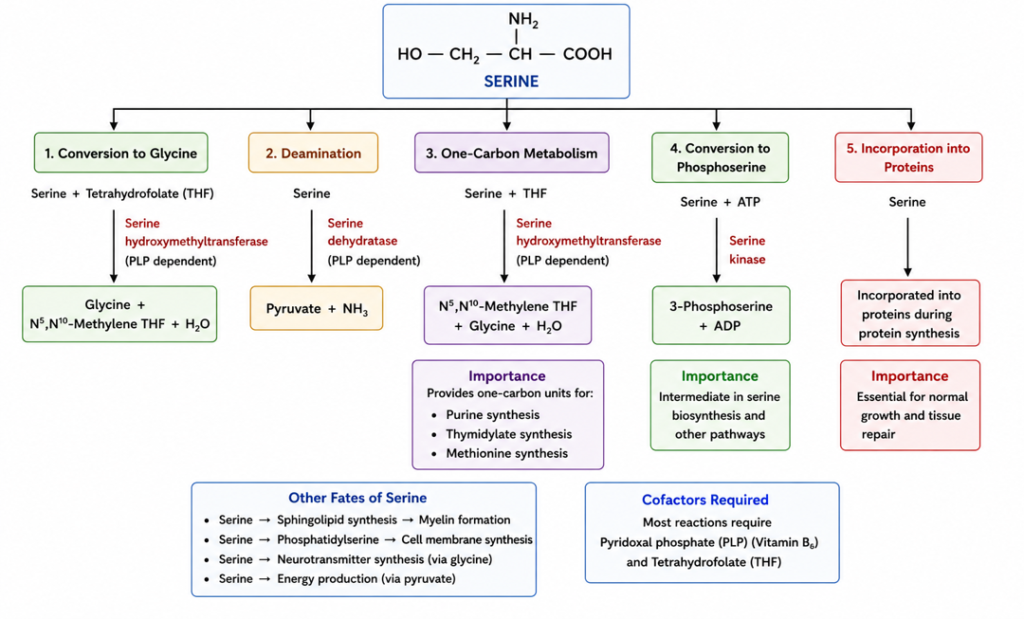
Degradation of Serine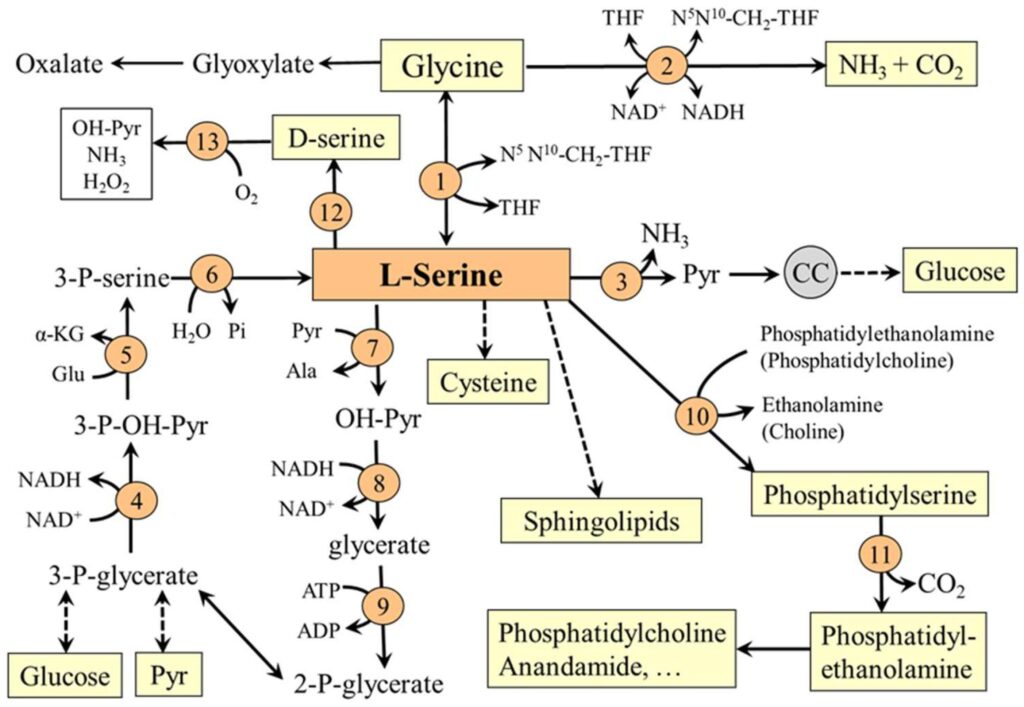
Serine is degraded mainly by deamination.
Reaction
Serine → Pyruvate + NH3
Enzyme
- Serine dehydratase
Importance
- Pyruvate enters glucose metabolism
- Serine is glucogenic
Specialized Products Synthesized from Serine
| Product | Importance |
|---|---|
| Glycine | Amino acid metabolism |
| Purines | DNA/RNA synthesis |
| Pyrimidines | Nucleotide synthesis |
| Sphingosine | Sphingolipid formation |
| Phosphatidylserine | Cell membrane structure |
| Cysteine | Sulfur amino acid metabolism |
Functions of Serine
1. Role in Glycine Formation
Serine is the major precursor of glycine.
Reaction
Serine + THF ⇌ Glycine + N5,N10-methylene THF
2. One-Carbon Metabolism
Serine provides one-carbon units required for:
- Purine synthesis
- Thymidylate synthesis
- DNA synthesis
3. Phospholipid Synthesis
Serine participates in synthesis of:
- Phosphatidylserine
- Cell membrane phospholipids
4. Sphingolipid Formation
Serine combines with palmitoyl-CoA to form sphingolipids.
Importance
- Brain development
- Myelin formation
- Nerve function
5. Energy Production
Serine is converted into pyruvate and enters:
- Glycolysis
- TCA cycle
Reaction
Serine → Pyruvate + NH3
6. Protein and Enzyme Synthesis
Serine is present in:
- Structural proteins
- Enzymes
- Active sites of many proteins
| Function | Importance |
|---|---|
| Protein synthesis | Structural component of proteins |
| Glycine synthesis | Precursor of glycine |
| One-carbon metabolism | Provides carbon units through THF |
| Purine and pyrimidine synthesis | DNA and RNA formation |
| Phospholipid synthesis | Cell membrane formation |
| Sphingolipid synthesis | Nervous system function |
| Energy metabolism | Converted to pyruvate |
| Cysteine synthesis | Sulfur amino acid metabolism |
Clinical Significance
1. Serine Deficiency Disorders
Defect in serine biosynthesis causes:
- Microcephaly
- Seizures
- Developmental delay
- Mental retardation
2. Cancer Metabolism
Rapidly growing tumor cells require serine for:
- DNA synthesis
- RNA synthesis
- Cell proliferation
Increased serine metabolism is seen in many cancers.
3. Nervous System Function
Serine is required for:
- Sphingolipid synthesis
- Myelin formation
- Brain development
Deficiency may cause neurological abnormalities.
4. One-Carbon Metabolism
Serine provides one-carbon units through THF.
Importance
Required for:
- Purine synthesis
- Thymidylate synthesis
- DNA formation
5. Vitamin B₆ and Folate Deficiency
These vitamins are essential for serine-glycine interconversion.
Deficiency Causes
- Impaired amino acid metabolism
- Reduced nucleotide synthesis
- Neurological defects
6. Energy Metabolism
Serine is converted into pyruvate and contributes to:
- Glucose metabolism
- ATP production
Reaction
Serine → Pyruvate + NH3
Disorders
| Disorder | Defect |
|---|---|
| 3-Phosphoglycerate dehydrogenase deficiency | Defective serine synthesis |
| Phosphoserine phosphatase deficiency | Reduced serine formation |
| Serine deficiency syndrome | Neurological abnormalities |