Introduction
- Oral Glucose Tolerance Test (OGTT) is a laboratory test used to assess how the body handles a measured oral glucose load.
- It is mainly used to evaluate glucose tolerance and carbohydrate metabolism.
- OGTT is an important test for the diagnosis of diabetes mellitus and impaired glucose tolerance.
- It is also widely used for the diagnosis of gestational diabetes mellitus (GDM) during pregnancy.
- The test measures blood glucose levels before and after administration of a standard amount of glucose.
- In healthy individuals, blood glucose increases after glucose intake and gradually returns toward the normal range.
- In diabetes or impaired glucose tolerance, blood glucose remains higher than expected after the glucose load.
Principle
- The OGTT is based on measuring the body’s response to a standardized oral glucose load.
- The patient is given a known amount of glucose solution, usually 75 g of anhydrous glucose in non-pregnant adults.
- A fasting blood glucose sample is collected before glucose administration.
- After consuming the glucose solution, blood samples are collected at specified time intervals.
- Blood glucose concentration is measured in each sample using a suitable enzymatic method.
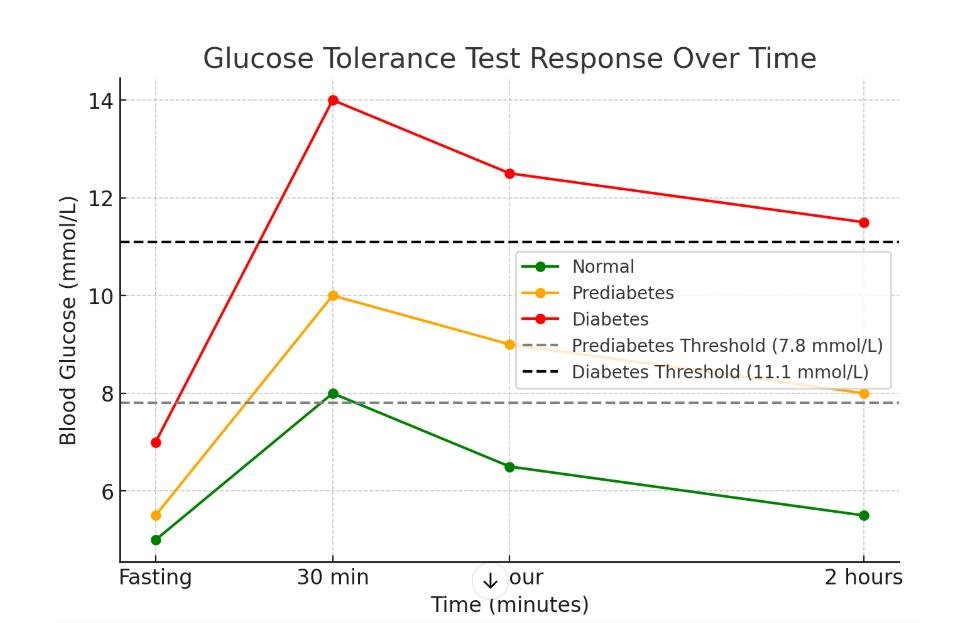
- In a healthy person, blood glucose rises after glucose intake and gradually returns toward the normal range.
- In impaired glucose tolerance or diabetes mellitus, blood glucose remains abnormally elevated for a longer period.
- The 2-hour plasma glucose value is particularly important for assessing glucose tolerance in the standard 75-g OGTT.
Indications
OGTT may be performed for:
- Diagnosis of diabetes mellitus when other results are uncertain.
- Detection of impaired glucose tolerance (IGT).
- Evaluation of abnormal fasting glucose.
- Assessment of suspected diabetes despite a non-diagnostic fasting glucose result.
- Diagnosis of gestational diabetes mellitus (GDM) according to the appropriate pregnancy protocol.
Patient Preparation
- The patient should have a normal diet and usual physical activity before the test unless otherwise instructed.
- An overnight fast of at least 8 – 12 hours is required for the standard 75-g OGTT in non-pregnant adults.
- No food or caloric beverages should be taken during the fasting period.
- Water is generally permitted.
- Smoking and strenuous physical activity should be avoided during the test.
- Medications that may affect glucose levels should be considered according to the clinician’s instructions.
Specimen Required
- Specimen: Venous blood
- Sample: Plasma is preferred for diagnostic testing.
- Blood is collected at the required time points, usually:
- Fasting (0 hour)
- 2 hours after glucose administration
Procedure
- Confirm that the patient has completed the required fasting period.
- Collect the fasting blood sample.
- Give 75 g of anhydrous glucose dissolved in water.
- The patient should consume the glucose solution within the specified time.
- Keep the patient resting during the test.
- Do not allow food, smoking, or strenuous activity during the test.
- Collect the 2 blood sample, every 1 hrs interval.
- Measure plasma glucose using an appropriate laboratory method.
- Interpret the results according to current diagnostic criteria.
Interpretation
According to the ADA Standards of Care 2026, the 2-hour plasma glucose value during a 75-g OGTT is interpreted as follows:
| 2-Hour Plasma Glucose | Interpretation |
|---|---|
| <140 mg/dL (<7.8 mmol/L) | Normal glucose tolerance |
| 140–199 mg/dL (7.8–11.0 mmol/L) | Impaired glucose tolerance (Prediabetes) |
| ≥200 mg/dL (≥11.1 mmol/L) | Diabetes mellitus |
 A diabetes-range result generally requires confirmation with repeat testing when there is no unequivocal hyperglycemia.
OGTT in Pregnancy
For the one-step 75-g OGTT used to diagnose gestational diabetes, plasma glucose is measured at fasting, 1 hour, and 2 hours.
| Time | GDM Diagnostic Threshold |
| Fasting | ≥92 mg/dL (5.1 mmol/L) |
| 1 hour | ≥180 mg/dL (10.0 mmol/L) |
| 2 hours | ≥153 mg/dL (8.5 mmol/L) |
Using this one-step approach, one abnormal value is sufficient for the diagnosis of GDM.
Causes of Abnormal
An abnormal OGTT may occur because of:
- Diabetes mellitus
- Prediabetes
- Gestational diabetes
- Insulin resistance
- Obesity
- Certain endocrine disorders
- Some medications
Factors Affecting
- Inadequate fasting
- Recent illness or infection
- Major changes in diet before testing
- Strenuous exercise
- Smoking during the test
- Certain medications
- Stress
- Vomiting or incomplete consumption of the glucose solution
Advantages
- Provides information about the body’s response to a standardized glucose load.
- Can detect impaired glucose tolerance that may not be identified by fasting glucose alone.
- Useful for diagnosis of gestational diabetes under appropriate protocols.
- Provides a standardized assessment of post-load glucose handling.
Limitations
- Requires several hours to complete.
- Requires fasting and proper patient preparation.
- Results can be affected by illness, medications, diet, and physical activity.
- Some patients may experience nausea, dizziness, or vomiting after drinking the glucose solution.
- Different clinical settings may use different OGTT protocols, particularly during pregnancy.