Introduction
- Translation is the process by which a cell makes a protein from the information present in mRNA.
- It is an important part of gene expression.
- Translation mainly takes place on structures called ribosomes.
- The mRNA contains codons, which tell the cell which amino acids should be added to the protein.
- tRNA brings the correct amino acids to the ribosome.
- The amino acids are joined together to form a polypeptide chain, which later folds to form a protein.
- A newly made protein may not be fully active immediately after translation.
- It may need some chemical changes or processing to become a functional protein.
- These changes are called post-translational modifications (PTMs).
- Common modifications include phosphorylation, glycosylation, acetylation, methylation, and ubiquitination.
- These modifications help control the activity, stability, location, and function of proteins.
- Therefore, translation and post-translational modifications are essential for normal cell function and human health.
Translation
Translation is the process of protein synthesis in which the nucleotide sequence of mRNA is read by a ribosome and converted into an amino acid sequence.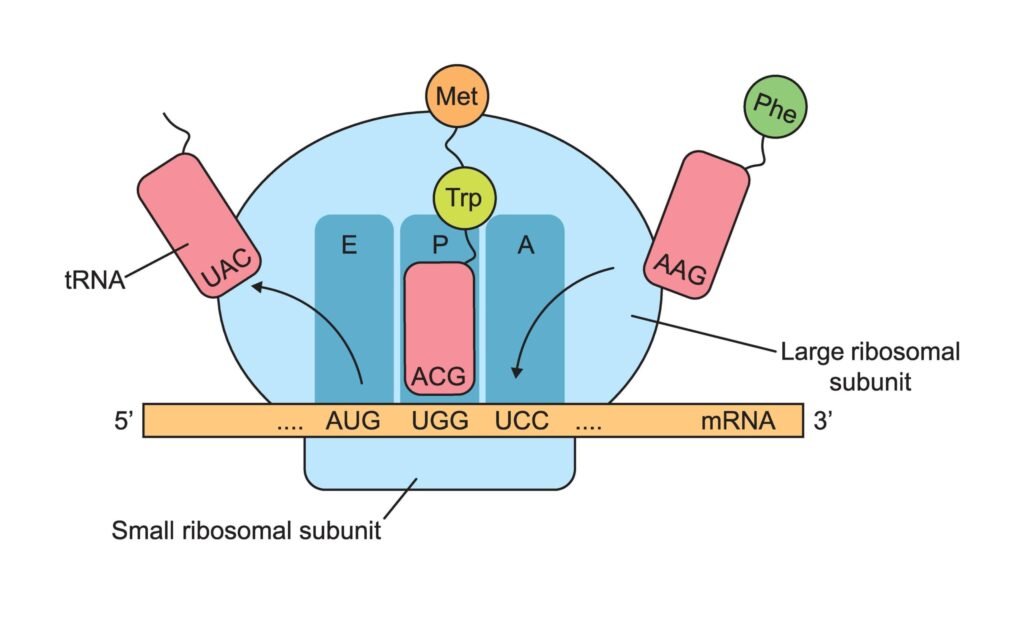
The basic flow of genetic information can be represented as:
DNA → RNA → Protein
The conversion of mRNA information into protein is called translation.
Components Required for Translation
Translation is the process of making a protein from the information present in mRNA. Several components work together to make this process possible.
1. Messenger RNA (mRNA)
- mRNA carries the genetic information needed to make a protein.
- It is produced from DNA during transcription.
- The information on mRNA is present in the form of codons.
- A codon consists of three nucleotides.
- Each codon specifies a particular amino acid or gives a signal to stop protein synthesis.
- AUG usually acts as the start codon.
- UAA, UAG, and UGA are stop codons.
Main function: Provides the instructions for the order of amino acids in the protein.
2. Ribosomes
- Ribosomes are the main site of protein synthesis.
- They read the codons present on mRNA.
- Ribosomes are made up of ribosomal RNA (rRNA) and proteins.
- They have two subunits:
- Small subunit
- Large subunit
- The ribosome contains three important sites:
- A site: receives incoming aminoacyl-tRNA.
- P site: holds the tRNA carrying the growing polypeptide.
- E site: allows the empty tRNA to leave.
Ribosomes in Different Organisms
- Prokaryotes: 70S ribosomes
- Eukaryotes: 80S ribosomes
Main function: Reads mRNA and helps join amino acids together.
3. Transfer RNA (tRNA)
- tRNA carries specific amino acids to the ribosome.
- Each tRNA has an anticodon.
- The anticodon pairs with the complementary codon on mRNA.
- This allows the correct amino acid to be added to the growing protein.
- Before participating in translation, tRNA must be attached to its correct amino acid.
Main function: Brings the correct amino acid according to the mRNA codon.
4. Amino Acids
- Amino acids are the basic building blocks of proteins.
- During translation, amino acids are joined together by peptide bonds.
- The order of amino acids determines the structure and function of the protein.
- Cells use 20 standard amino acids to make proteins.
Main function: Form the actual polypeptide chain.
5. Aminoacyl-tRNA Synthetases
- These are special enzymes that attach the correct amino acid to its corresponding tRNA.
- This process is called tRNA charging or aminoacylation.
- Each amino acid has its own specific aminoacyl-tRNA synthetase or corresponding enzyme specificity.
- These enzymes are important for maintaining the accuracy of protein synthesis.
Main function: Ensures that the correct amino acid is attached to the correct tRNA.
6. Energy
Translation requires a considerable amount of energy.
- ATP is mainly used during the attachment of amino acids to tRNA.
- GTP is used during several steps of translation, including:
- Initiation
- tRNA delivery
- Ribosome movement
- Termination
Main function: Provides energy required for different steps of protein synthesis.
7. Initiation Factors
- Initiation factors help start the translation process.
- They assist in:
- Binding of ribosome to mRNA
- Recognition of the start codon
- Positioning of the initiator tRNA
- Assembly of the complete ribosome
Main function: Help in the starting of translation.
8. Elongation Factors
- Elongation factors help the protein chain grow.
- They assist in bringing the correct tRNA to the ribosome.
- They also help the ribosome move along the mRNA.
Main function: Help in the addition of amino acids to the growing protein.
9. Release Factors
- Release factors are involved in the termination of translation.
- When the ribosome reaches a stop codon, a release factor recognizes the signal.
- It helps release the newly synthesized polypeptide from the ribosome.
Main function: Help end translation and release the protein.
10. Peptide Bond-Forming Activity
- Amino acids are connected by peptide bonds.
- The ribosome’s large subunit contains the catalytic center responsible for peptide-bond formation.
- This activity is mainly associated with ribosomal RNA.
Main function: Connects amino acids to form the polypeptide chain.
11. Stop Codons
Stop codons are also important for translation.
The three stop codons are:
- UAA
- UAG
- UGA
- They do not code for amino acids.
- They signal that protein synthesis should stop.
- Release factors recognize these codons and help release the completed protein.
Genetic Code
The genetic code is the set of rules used by cells to convert the information in mRNA into a protein. It tells the cell which amino acid should be added at each step during translation.
- Genetic code is present in mRNA in the form of three-letter units called codons.
- A codon consists of three nucleotides. For example, AUG is a codon.
- Each codon usually specifies one amino acid.
- There are 64 possible codons made from the four RNA bases: A, U, G, and C.
- Out of these 64 codons, 61 code for amino acids.
- The remaining 3 codons (UAA, UAG, and UGA) are stop codons. They tell the ribosome to stop protein synthesis.
- AUG is the most common start codon. It also codes for the amino acid methionine.
- The genetic code is degenerate, which means that more than one codon can code for the same amino acid. For example, several different codons can specify leucine.
- The genetic code is generally universal, meaning that most organisms use the same codons for the same amino acids, with a few exceptions.
- The codons on mRNA are read by the ribosome, while tRNA brings the correct amino acids according to these codons.
Stages of Translation
Translation can be described in four main stages:
- Activation of Amino Acids
- Initiation
- Elongation
- Termination
1. Activation of Amino Acids
- Before an amino acid can be used for protein synthesis, it must be attached to its specific tRNA.
- This process is called activation or charging of tRNA.
- The enzyme aminoacyl-tRNA synthetase attaches the correct amino acid to its tRNA.
- ATP provides the energy required for this process.
- The resulting molecule is called aminoacyl-tRNA or charged tRNA.
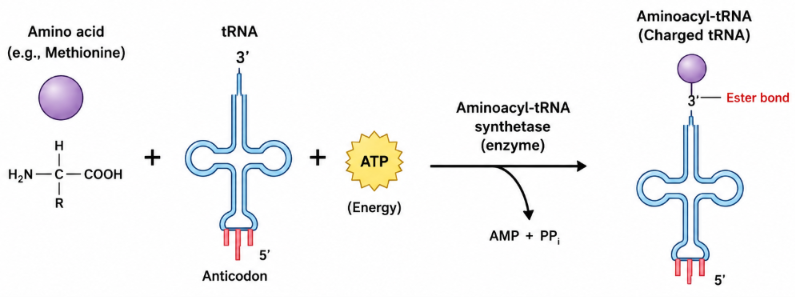
Activation = Preparing amino acids for protein synthesis
2. Initiation
- This is the starting stage of protein synthesis.
- The ribosome attaches to the mRNA.
- The ribosome identifies the start codon (AUG).
- The initiator tRNA carrying methionine pairs with AUG.
- The large ribosomal subunit joins the complex.
- The complete ribosome is now ready for protein synthesis.
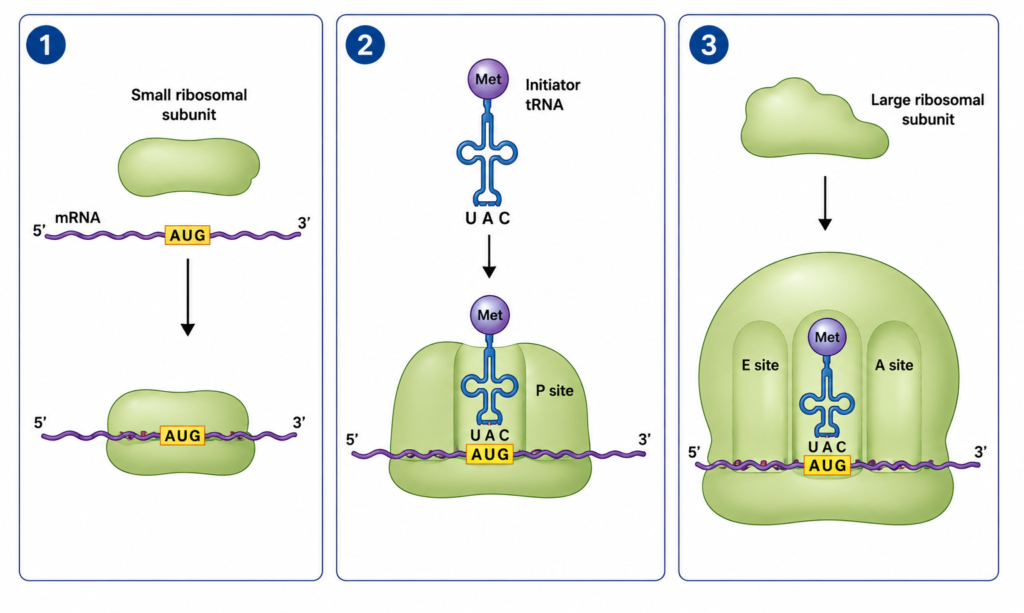
Initiation = Starting protein synthesis
3. Elongation
- In this stage, the protein chain becomes longer.
- Charged tRNAs bring amino acids to the ribosome.
- The anticodon of each tRNA pairs with the appropriate mRNA codon.
- The ribosome forms peptide bonds between amino acids.
- The ribosome moves along the mRNA.
- More amino acids are added one by one.
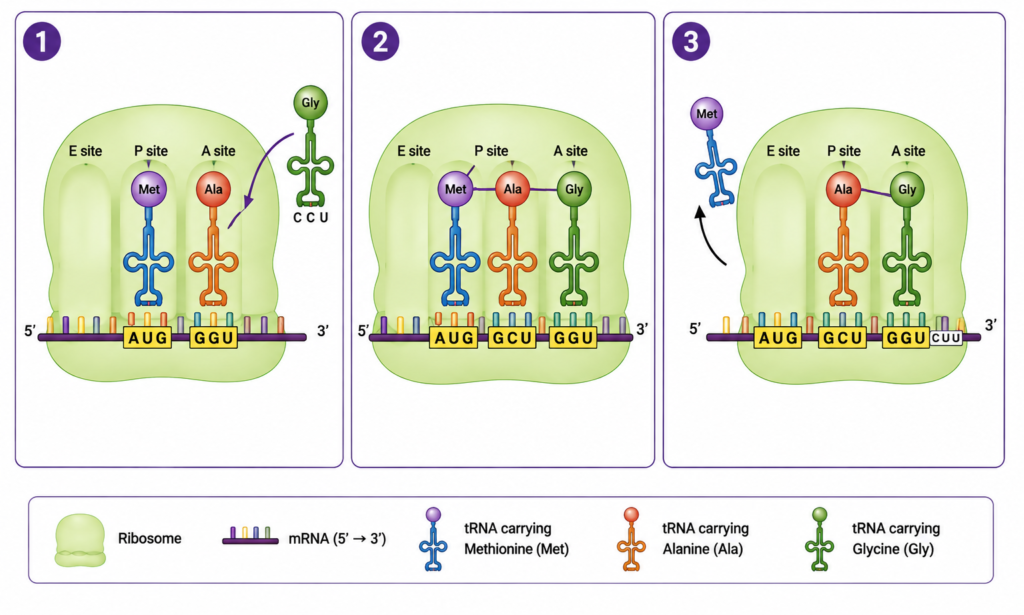
Elongation = Adding amino acids
4. Termination
- Translation continues until the ribosome reaches a stop codon.
- The three stop codons are:
- UAA
- UAG
- UGA
- Stop codons do not code for amino acids.
- Release factors help release the completed polypeptide.
- The ribosome separates from the mRNA.
- The newly formed protein is released.
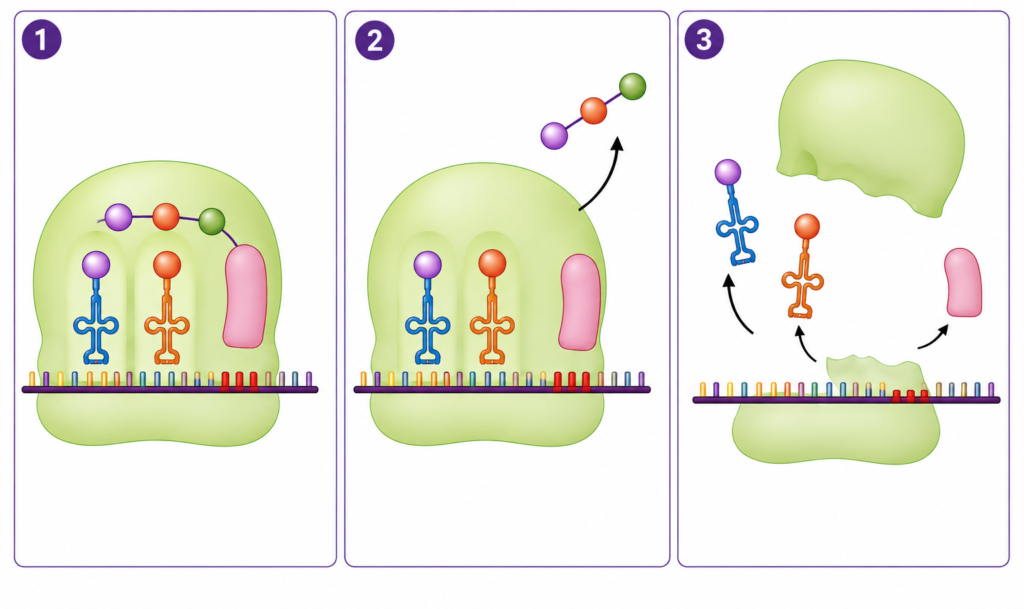
Termination = Stopping protein synthesis
Polyribosomes or Polysomes
- Polyribosomes (polysomes) are groups of several ribosomes attached to the same mRNA molecule.
- Each ribosome reads the mRNA and makes a separate protein molecule.
- All ribosomes on the polysome can work at the same time.
- This helps the cell produce many copies of the same protein quickly.
- Polysomes are found in both prokaryotic and eukaryotic cells.
Protein Folding
Translation produces a linear polypeptide chain, but proteins normally need a specific three-dimensional structure to function.
Protein folding involves:
- Formation of secondary structures.
- Formation of tertiary structures.
- Assembly of multiple subunits in some proteins.
Important structural interactions include:
- Hydrogen bonds
- Ionic interactions
- Hydrophobic interactions
- Disulfide bonds
Molecular Chaperones
- Molecular chaperones help newly synthesized proteins fold correctly.
- They can prevent inappropriate protein aggregation.
- Examples include members of the Hsp70 and chaperonin families.
Post-Translational Modifications
- Post-translational modifications (PTMs) are changes that occur to a protein after it is made during translation.
- A newly formed protein may need further changes before it can work properly.
- PTMs can change the structure, activity, stability, or location of a protein.
- These modifications are carried out by specific enzymes and cellular processes.
- PTMs can occur in different parts of the cell, such as the cytoplasm, endoplasmic reticulum, and Golgi apparatus.
- Common PTMs include phosphorylation, glycosylation, acetylation, methylation, and ubiquitination.
- Some proteins are also modified by cleavage, hydroxylation, lipidation, or disulfide bond formation.
- PTMs are important for cell signaling, metabolism, protein folding, and regulation of cellular functions.
- Abnormal PTMs can affect protein function and may contribute to various diseases.
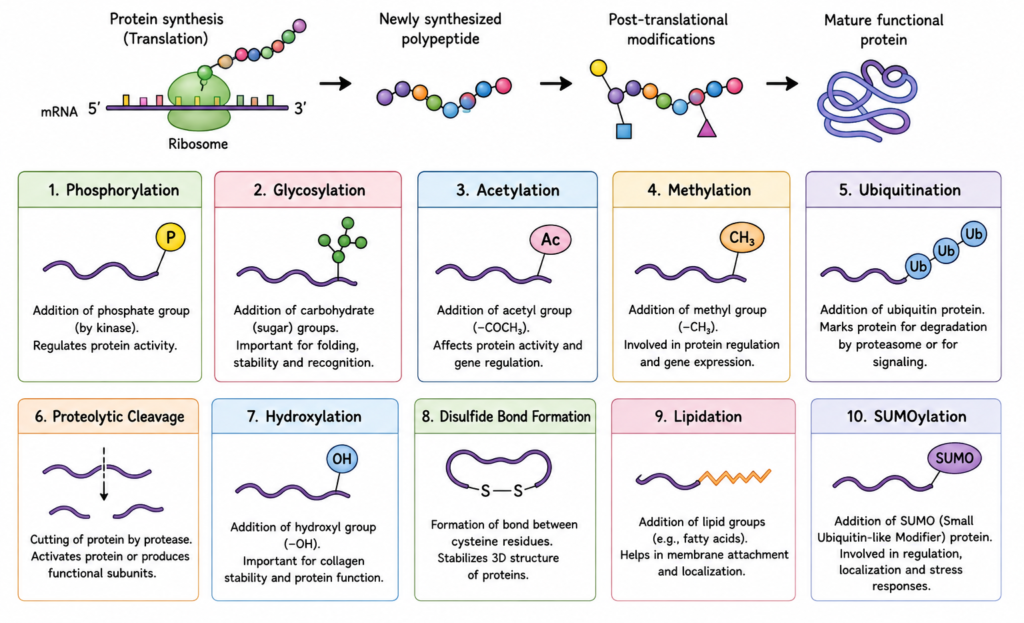
Functions of Post-Translational Modifications
PTMs can:
- Activate proteins.
- Inactivate proteins.
- Change enzyme activity.
- Alter protein stability.
- Control protein degradation.
- Direct proteins to specific cellular locations.
- Facilitate protein-protein interactions.
- Change protein solubility.
- Regulate cell signaling.
- Help proteins fold correctly.
- Increase the functional diversity of proteins.
Types of PTMs
After a protein is made by translation, it may undergo different chemical changes. These changes are called post-translational modifications (PTMs). They help proteins become active, stable, correctly folded, and properly located inside or outside the cell.
The major types are –
1. Phosphorylation
- Phosphorylation means adding a phosphate group (PO₄) to a protein.
- It is one of the most common and important PTMs.
- The enzymes that add phosphate groups are called kinases.
- Enzymes called phosphatases remove phosphate groups.
- Phosphorylation can change the activity of a protein.
- It may activate or deactivate a protein.
- It is very important in cell signaling, metabolism, and cell division.
Easy example:
A signaling protein may become active after phosphorylation.
Remember:
Kinase → adds phosphate
Phosphatase → removes phosphate
2. Glycosylation
- Glycosylation means adding carbohydrate (sugar) groups to a protein.
- It commonly occurs in the endoplasmic reticulum (ER) and Golgi apparatus.
- Glycosylation can help a protein:
- Fold correctly
- Become more stable
- Reach the correct location
- Interact with other cells or molecules
- It is especially common in membrane proteins and secreted proteins.
Main Types
- N-linked glycosylation: Sugar is attached to the nitrogen of an asparagine residue.
- O-linked glycosylation: Sugar is attached to the oxygen of serine or threonine residues.
Example: Many antibodies and cell-surface receptors contain carbohydrate groups.
3. Acetylation
- Acetylation means adding an acetyl group (–COCH₃) to a protein.
- It commonly occurs on the amino acid lysine.
- It can change the activity, stability, or interactions of a protein.
- Acetylation is particularly important in histones.
Importance of Histone Acetylation
- Histones are proteins around which DNA is wrapped.
- Acetylation can change how tightly DNA is associated with histones.
- This can influence whether certain genes are more or less accessible for expression.
Easy to remember:
Acetylation → important in protein regulation and gene expression.
4. Methylation
- Methylation means adding a methyl group (–CH₃) to a protein.
- It commonly occurs on lysine and arginine residues.
- Methylation can change protein interactions and activity.
- It is particularly important in gene regulation.
Example
Histone methylation can influence how genes are regulated by changing the organization and activity of chromatin.
Easy to remember:
Methylation → important in protein regulation and gene control.
5. Ubiquitination
- Ubiquitination is the attachment of a small protein called ubiquitin to another protein.
- Ubiquitin acts like a cellular label.
- A chain of ubiquitin molecules can mark a protein for destruction by the proteasome.
- This helps the cell remove:
- Damaged proteins
- Misfolded proteins
- Unwanted proteins
- Proteins that have completed their function
Other Functions
Ubiquitination can also participate in:
- DNA repair
- Cell-cycle regulation
- Cell signaling
- Protein trafficking
Easy to remember:
Ubiquitin → often marks a protein for degradation.
6. Proteolytic Cleavage
- Proteolytic cleavage means cutting a protein into smaller pieces using protease enzymes.
- Some proteins are produced as inactive precursor proteins.
- They become active only after a specific part is removed.
Example: Insulin
Proinsulin → Proteolytic cleavage → Insulin
- Proinsulin is produced as a precursor.
- Specific portions are removed.
- The remaining molecule becomes mature insulin.
Importance
Proteolytic cleavage is important for the activation of:
- Hormones
- Digestive enzymes
- Blood-clotting proteins
- Some signaling proteins
Easy to remember:
Cleavage → Inactive precursor becomes active protein.
7. Hydroxylation
- Hydroxylation means adding a hydroxyl group (–OH) to a protein.
- It commonly occurs on amino acids such as proline and lysine.
- It is particularly important in collagen formation.
Importance in Collagen
- Hydroxylation helps collagen maintain its proper structure.
- Vitamin C is important for enzymes involved in collagen hydroxylation.
- Poor collagen hydroxylation can weaken connective tissues.
Easy to remember:
Hydroxylation → important for collagen stability.
8. Disulfide Bond Formation
- A disulfide bond is a strong bond formed between two cysteine residues.
- These bonds help maintain the correct three-dimensional shape of proteins.
- They are particularly important in proteins found outside the cell and in the secretory pathway.
Example
Insulin contains disulfide bonds that help maintain its structure.
Importance
Disulfide bonds help:
- Stabilize protein structure
- Maintain proper protein folding
- Increase resistance to structural changes
Easy to remember:
Cysteine + Cysteine → Disulfide bond
9. Lipidation
- Lipidation means attaching a lipid group to a protein.
- Lipids are fat-like molecules.
- Adding a lipid can help a protein attach to a cell membrane.
- It can also help direct proteins to their correct location.
Examples
- Myristoylation
- Palmitoylation
- Prenylation
Importance
Lipidation is important for:
- Membrane attachment
- Cell signaling
- Protein localization
- Protein trafficking
Easy to remember:
Lipidation → helps proteins associate with membranes.
10. SUMOylation
- SUMOylation involves attaching a small protein called SUMO (Small Ubiquitin-like Modifier) to another protein.
- It is similar to ubiquitination but usually has different effects.
- It can change the location, activity, or interactions of a protein.
Functions
- Regulation of gene expression
- DNA repair
- Protein localization
- Cellular stress responses
Regulation of Translation
Cells carefully control protein production according to their requirements.
Translation can be regulated by:
- Availability of mRNA.
- Ribosome availability.
- Initiation factors.
- Availability of amino acids.
- Cellular energy status.
- Regulatory proteins.
- Small RNAs such as microRNAs in eukaryotes.
- Signaling pathways.
Regulation helps cells avoid unnecessary protein production and respond rapidly to environmental changes.
Translation vs Post-Translational Modifications
| Feature | Translation | Post-Translational Modifications |
|---|---|---|
| Definition | Synthesis of protein from mRNA | Changes made to proteins after/during synthesis |
| Main machinery | Ribosome | Various enzymes and cellular systems |
| Main components | mRNA, tRNA, amino acids, ribosome | Kinases, glycosyltransferases, proteases, etc. |
| Main purpose | Produce polypeptide | Produce mature functional protein |
| Examples | Initiation, elongation, termination | Phosphorylation, glycosylation, ubiquitination |
| Major outcome | Amino acid chain | Modified and functional protein |
Clinical Significance
- Translation is essential for gene expression and protein synthesis.
- The sequence of amino acids determines the basic structure of a protein.
- Post-translational modifications further regulate protein structure and function.
- A single protein can undergo several different PTMs.
- PTMs provide cells with an efficient way to regulate proteins without synthesizing an entirely new protein.
- Abnormal translation, folding, or PTMs can contribute to human disease.
- Understanding these processes is fundamental to biochemistry, molecular biology, genetics, and clinical laboratory science.