Introduction
- Glucose is an important source of energy for the human body.
- Excess glucose is stored mainly in the liver and skeletal muscles as glycogen.
- During fasting, between meals, or exercise, stored glycogen is broken down.
- This process is called glycogenolysis.
- Glycogenolysis mainly produces glucose-1-phosphate, which is converted into glucose-6-phosphate.
- In the liver, glucose-6-phosphate can be converted into free glucose and released into the blood.
What is Glycogenolysis?
Glycogenolysis means the breakdown of glycogen.
- Glycogen is the storage form of glucose.
- Glycogen is stored mainly in the liver and skeletal muscles.
- Glycogenolysis releases glucose units from glycogen.
- The process occurs mainly when the body requires additional energy.
- It helps maintain blood glucose levels and provides energy for muscle contraction.
Definition
Glycogenolysis is the breakdown of glycogen into glucose-1-phosphate and glucose to provide energy or maintain blood glucose levels.
Sites of Glycogenolysis
Glycogenolysis occurs mainly in the liver and skeletal muscles. The purpose of glycogen breakdown is different in these two tissues.
1. Liver
- The liver stores glycogen as a reserve of glucose.
- During fasting or between meals, liver glycogen is broken down.
- The released glucose helps maintain normal blood glucose levels.
- The liver contains glucose-6-phosphatase, which converts glucose-6-phosphate into free glucose.
- Free glucose is then released into the bloodstream.
Main function: Maintain blood glucose levels.
2. Skeletal Muscle
- Skeletal muscles store glycogen mainly for their own energy requirements.
- Glycogen is broken down during exercise and muscle contraction.
- Glucose-6-phosphate enters glycolysis to produce ATP.
- Skeletal muscle lacks significant glucose-6-phosphatase activity.
- Therefore, muscle glycogen cannot directly contribute free glucose to the bloodstream.
Main function: Provide energy for muscle contraction.
When Does Glycogenolysis Occur?
Glycogenolysis increases when the body needs more glucose or energy.
Important situations include:
- Between meals
- During fasting
- During prolonged exercise
- During strenuous physical activity
- During stress
- When blood glucose levels fall
The hormonal response depends on the tissue.
| Condition | Major Hormone | Main Effect |
|---|---|---|
| Low blood glucose | Glucagon | ↑ Liver glycogenolysis |
| Exercise | Adrenaline | ↑ Muscle glycogenolysis |
| Stress | Adrenaline | ↑ Glycogen breakdown |
| Rest after meals | Insulin | ↓ Glycogenolysis |
Structure of Glycogen
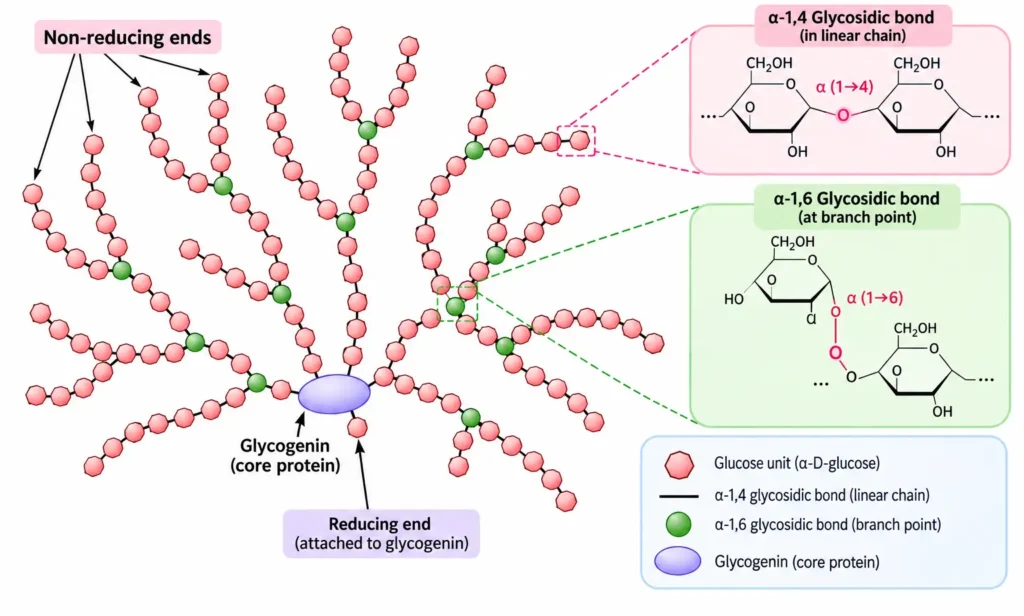
Glycogen is the main storage form of glucose in animals. It is a highly branched polysaccharide made up of many glucose molecules.
1. Glucose Units
- Glycogen consists of a large number of α-D-glucose molecules.
- These glucose molecules are joined together to form long chains.
- The chains are highly branched, making glycogen compact and easily accessible.
2. α-1,4 Glycosidic Bonds
- Glucose molecules in the main chain are connected by α-1,4 glycosidic bonds.
- These bonds form the linear portions of glycogen.
Glucose — α(1→4) — Glucose — α(1→4) — Glucose
3. α-1,6 Glycosidic Bonds
- Branches are formed by α-1,6 glycosidic bonds.
- A branch usually occurs after approximately 8–12 glucose residues.
- This branching creates many non-reducing ends from which glucose can be rapidly added or removed.
4. Reducing and Non-Reducing Ends
- Glycogen has one reducing end.
- The reducing end is attached to a core protein called glycogenin.
- It has many non-reducing ends.
- Glycogen synthesis and breakdown mainly occur at the non-reducing ends.
5. Highly Branched Structure
The highly branched structure of glycogen has two major advantages:
- It allows rapid glycogen synthesis when glucose is abundant.
- It allows rapid glycogen breakdown when energy or glucose is required.
Steps of Glycogenolysis
Glycogenolysis can be understood in three major steps:
- Removal of glucose residues from glycogen
- Removal of branch points
- Conversion of glucose-1-phosphate to glucose-6-phosphate
In the liver, an additional step converts glucose-6-phosphate into free glucose.
Step 1: Action of Glycogen Phosphorylase
- The first major enzyme in glycogenolysis is glycogen phosphorylase.
- It removes glucose residues from the non-reducing ends of glycogen.
- The enzyme breaks α-1,4 glycosidic bonds using inorganic phosphate (Pi).
Reaction
- Glycogen + Pi → Glycogen shortened by one glucose + Glucose-1-phosphate
The major product is therefore:
- Glucose-1-phosphate (G1P)
- Glycogen phosphorylase continues removing glucose residues until it approaches a branch point.
Step 2: Removal of Branch Points
- Glycogen phosphorylase cannot remove glucose directly from the α-1,6 branch point.
- Therefore, a debranching enzyme is required.
The glycogen debranching enzyme has two activities:
A. Transferase activity
- The enzyme transfers a small chain of glucose residues from the branch to the main chain.
B. α-1,6-glucosidase activity
- The enzyme breaks the remaining α-1,6 glycosidic bond.
- This releases one free glucose molecule.
Important point
Most glucose released during glycogenolysis is released as:
- Glucose-1-phosphate
Only a small amount is released directly as:
- Free glucose
Step 3: Conversion of Glucose-1-Phosphate
- Glucose-1-phosphate cannot directly enter glycolysis.
It is converted into glucose-6-phosphate by the enzyme:
- Phosphoglucomutase
- Glucose-1-phosphate ⇌ Glucose-6-phosphate
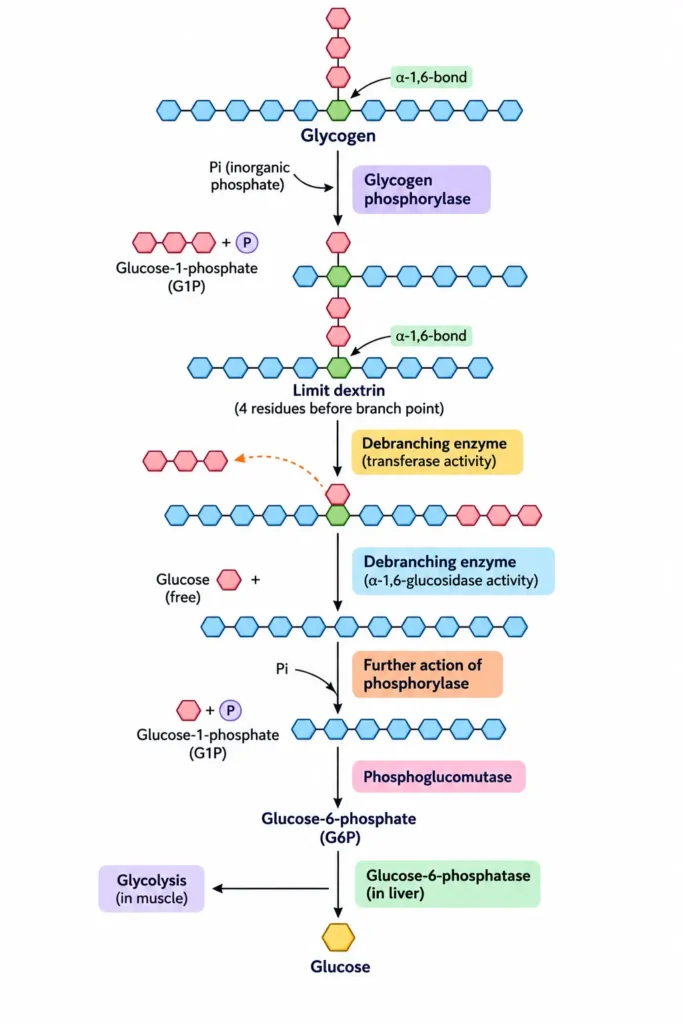
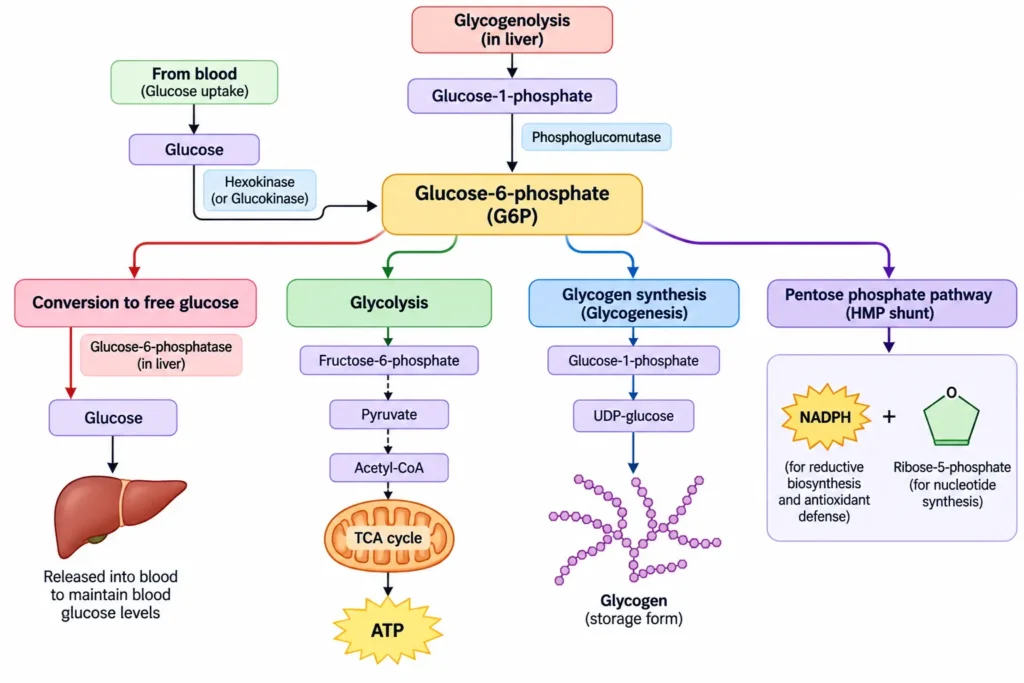
Glucose-6-phosphate can then follow different metabolic pathways depending on the tissue.
Fate of Glucose-6-Phosphate in Muscle
In skeletal muscle, glucose-6-phosphate mainly enters glycolysis.
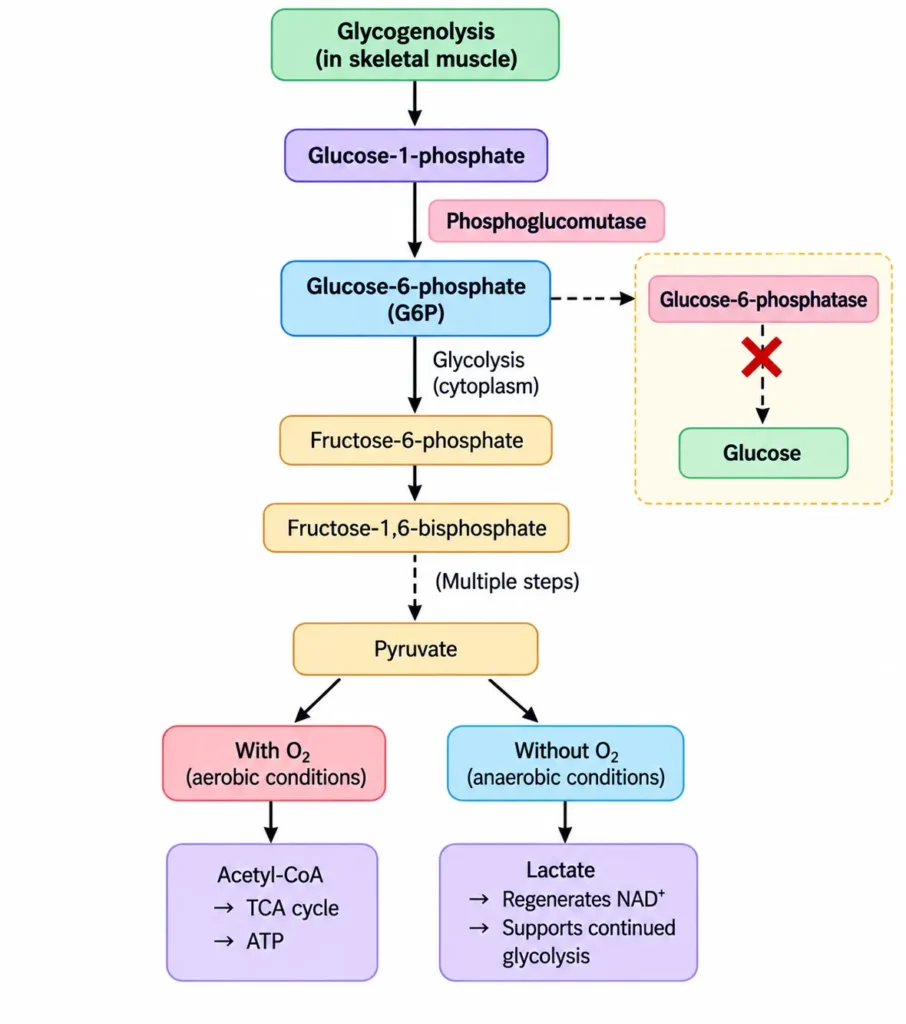
Therefore, muscle glycogen provides a rapid source of energy during muscle activity.
Fate of Glucose-6-Phosphate in Liver
- The liver has the enzyme glucose-6-phosphatase.
- This enzyme converts glucose-6-phosphate into free glucose.
Reaction
- Glucose-6-phosphate → Glucose + Pi
- The free glucose is then released into the bloodstream.
Main purpose
The liver uses glycogenolysis primarily to:
Maintain blood glucose levels during fasting and between meals.
Regulation of Glycogenolysis
Glycogenolysis is tightly regulated according to the body’s energy requirements.
Three major types of regulation are:
- Hormonal regulation
- Allosteric regulation
- Influence of calcium
1. Hormonal Regulation
A. Glucagon
Glucagon is released from pancreatic α-cells when blood glucose levels decrease.
It mainly acts on the liver.
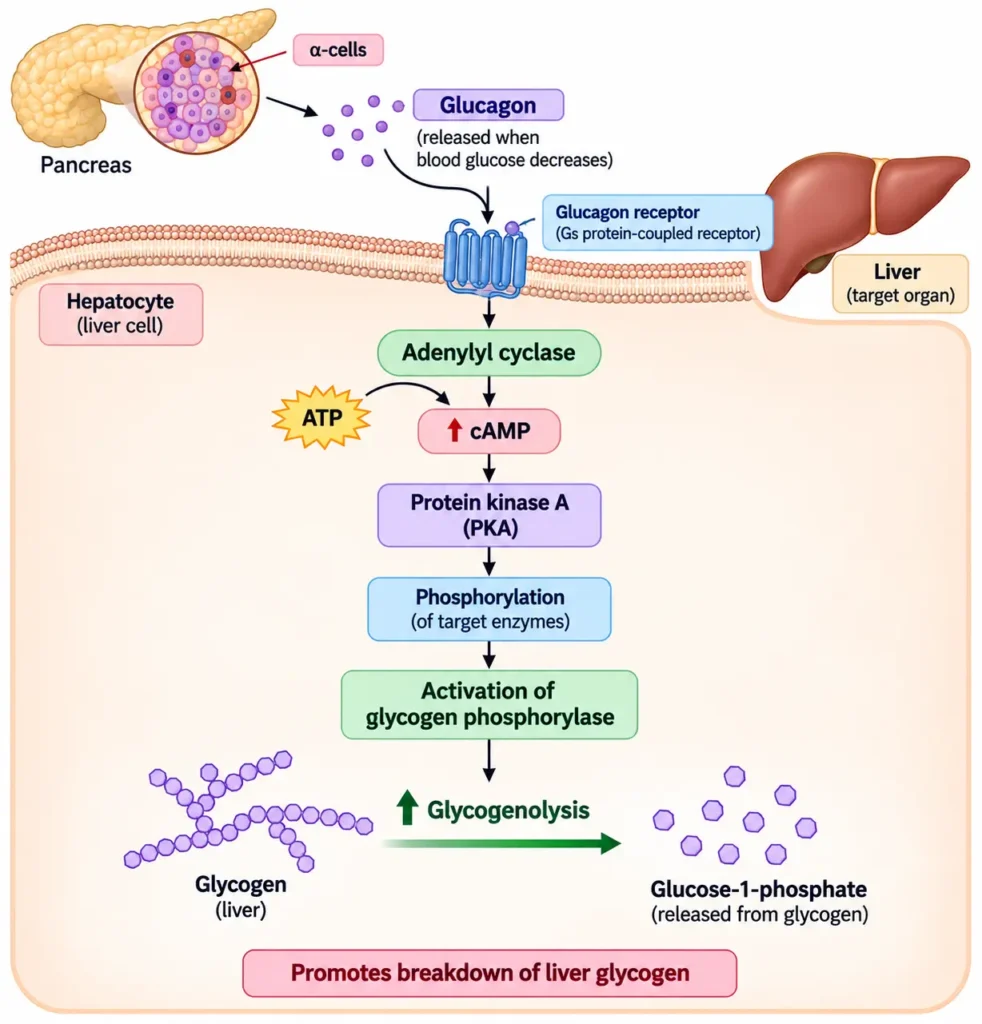
Thus, glucagon promotes liver glycogen breakdown.
B. Adrenaline
Adrenaline is released during:
- Exercise
- Stress
- Fear
- Acute physical activity
It stimulates glycogenolysis, particularly in skeletal muscle.
This provides rapid energy for muscle contraction.
C. Insulin
Insulin is released when blood glucose levels increase, particularly after a meal.
Insulin promotes glycogen synthesis and inhibits glycogen breakdown.
Therefore:
Insulin → ↓ Glycogenolysis
and
Glucagon/Adrenaline → ↑ Glycogenolysis
2. Allosteric regulation
Allosteric regulation controls glycogenolysis according to the energy status of the cell. It is especially important in skeletal muscle, where glycogen is used to produce energy.
In Skeletal Muscle
- AMP activates glycogen phosphorylase when cellular energy is low.
- Increased AMP indicates that the muscle needs more ATP.
- Activation of glycogen phosphorylase increases glycogen breakdown.
- ATP inhibits glycogen phosphorylase when sufficient energy is available.
- Glucose-6-phosphate (G6P) also inhibits glycogen phosphorylase.
- Therefore, low-energy conditions promote glycogenolysis, whereas high-energy conditions suppress it.
In Liver
- Glucose acts as an important allosteric inhibitor of liver glycogen phosphorylase.
- When blood glucose is high, glucose inhibits glycogen phosphorylase.
- This reduces glycogen breakdown and favors glucose storage.
3. Influence of calcium
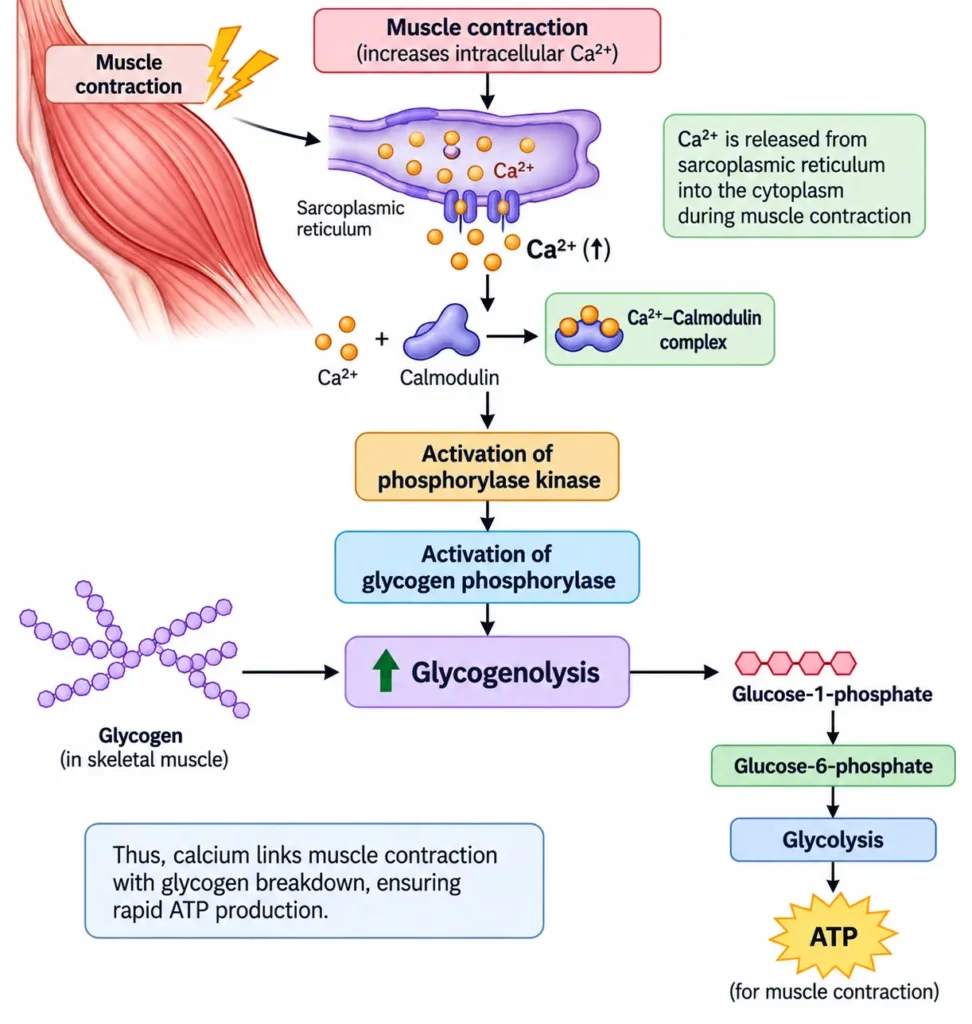
Glycogenolysis vs Glycogenesis
These two pathways have opposite functions.
| Feature | Glycogenolysis | Glycogenesis |
|---|---|---|
| Meaning | Breakdown of glycogen | Formation of glycogen |
| Main purpose | Provides glucose/energy | Stores excess glucose |
| Major enzyme | Glycogen phosphorylase | Glycogen synthase |
| Main product | Glucose-1-phosphate | Glycogen |
| Stimulated by | Glucagon, adrenaline | Insulin |
| During fasting | Increased | Decreased |
| During exercise | Increased | Decreased |
Liver vs Muscle Glycogenolysis
| Feature | Liver | Skeletal Muscle |
|---|---|---|
| Main purpose | Maintain blood glucose | Provide energy for muscle |
| Major stimulus | Glucagon | Adrenaline, Ca²⁺, AMP |
| Glucose-6-phosphatase | Present | Essentially absent |
| Free glucose released into blood | Yes | No |
| Major fate of G6P | Free glucose | Glycolysis |
| Importance | Fasting | Exercise |
Clinical Importance
Defects in glycogen metabolism can cause glycogen storage diseases (GSDs).
These disorders result from deficiencies in enzymes involved in glycogen synthesis or breakdown.
1. Maintenance of Blood Glucose
- The liver stores glucose as glycogen after meals.
- During fasting, liver glycogen is broken down by glycogenolysis.
- Glycogen is converted into glucose-1-phosphate, which is then converted into glucose-6-phosphate.
- In the liver, glucose-6-phosphatase converts glucose-6-phosphate into free glucose.
- Glucose is released into the bloodstream.
- This helps maintain blood glucose between meals and during short-term fasting.
Flow:
Liver glycogen → G1P → G6P → Glucose → Blood
2. Energy Production in Skeletal Muscle
- Skeletal muscle stores glycogen mainly for its own energy requirements.
- During exercise, muscle glycogen undergoes glycogenolysis.
- Glucose-1-phosphate is converted into glucose-6-phosphate.
- Glucose-6-phosphate enters glycolysis.
- Glycolysis produces ATP required for muscle contraction.
- Therefore, impaired glycogenolysis can cause exercise intolerance and muscle symptoms.
Flow:
Muscle glycogen → G1P → G6P → Glycolysis → ATP
3. Glycogen Storage Diseases
Glycogen storage diseases are inherited disorders caused by defects in enzymes involved in glycogen synthesis, breakdown, or processing.
| Type | Disease | Main defect | Major tissue affected | Main clinical features |
|---|---|---|---|---|
| GSD I | Von Gierke disease | Glucose-6-phosphatase system | Liver | Severe fasting hypoglycemia, hepatomegaly |
| GSD II | Pompe disease | Lysosomal acid α-glucosidase | Muscle, heart | Muscle weakness, cardiomyopathy |
| GSD IV | Andersen disease | Branching enzyme | Mainly liver | Hepatomegaly, progressive liver disease |
| GSD V | McArdle disease | Muscle glycogen phosphorylase | Skeletal muscle | Exercise intolerance, cramps, rhabdomyolysis |
| GSD VI | Hers disease | Liver glycogen phosphorylase | Liver | Mild fasting hypoglycemia, hepatomegaly |
The clinical presentation depends on the enzyme affected and the tissue involved.
4. Von Gierke Disease — GSD Type I
Cause
- Caused by defects in the glucose-6-phosphatase system.
- The liver cannot efficiently convert glucose-6-phosphate into free glucose.
Metabolic effect
G6P ✕→ Glucose
- Glucose-6-phosphate accumulates in the liver.
- Hepatic glucose release during fasting is impaired.
Major clinical features
- Severe fasting hypoglycemia
- Hepatomegaly
- Lactic acidosis
- Hyperuricemia
- Hyperlipidemia
- Growth retardation may occur
Clinical significance
The inability to release glucose from the liver makes maintaining blood glucose during fasting particularly difficult.
5. Hers Disease — GSD Type VI
Cause
- Usually caused by deficiency of liver glycogen phosphorylase.
- Glycogen breakdown in the liver is reduced.
Metabolic effect
Glycogen → G1P ↓
- Excess glycogen may accumulate in the liver.
- Glucose availability during fasting may be reduced.
Major clinical features
- Hepatomegaly
- Mild fasting hypoglycemia
- Growth retardation may occur
- Increased liver glycogen
- Mild elevation of liver enzymes may occur
Clinical significance
The disorder primarily affects hepatic glycogenolysis and is generally associated with milder hypoglycemia than GSD type I.
6. McArdle Disease — GSD Type V
Cause
- Caused by deficiency of muscle glycogen phosphorylase (myophosphorylase).
- The skeletal muscle cannot effectively mobilize glycogen during exercise.
Metabolic effect
Muscle glycogen → G1P ↓ → Glycolysis ↓
- Reduced availability of glucose-6-phosphate limits energy production during exercise.
Major clinical features
- Exercise intolerance
- Muscle cramps
- Muscle pain
- Early fatigue
- Muscle stiffness
- Rhabdomyolysis after strenuous exercise
- Myoglobinuria may occur
- Second-wind phenomenon may be observed
Clinical significance
McArdle disease is an important example of a disorder in which defective glycogenolysis primarily affects skeletal muscle energy production.
7. Pompe Disease — GSD Type II
Cause
- Caused by deficiency of lysosomal acid α-glucosidase (acid maltase).
- This enzyme is responsible for lysosomal glycogen degradation.
Metabolic effect
- Glycogen accumulates inside lysosomes.
- Accumulation particularly affects muscle tissues.
Major clinical features
- Muscle weakness
- Hypotonia
- Respiratory muscle weakness
- Cardiomyopathy, particularly in infantile disease
- Feeding difficulties may occur in infants
Clinical significance
Pompe disease demonstrates that glycogen degradation also occurs through a lysosomal pathway, in addition to the major cytosolic glycogenolysis pathway.
8. Andersen Disease — GSD Type IV
Cause
- Caused by deficiency of the glycogen branching enzyme.
- The enzyme is required for the normal branching of glycogen.
Metabolic effect
- Abnormally structured glycogen is produced.
- Abnormal glycogen accumulates in tissues.
Major clinical features
- Hepatomegaly
- Progressive liver dysfunction
- Liver fibrosis
- Cirrhosis
- Growth retardation may occur
Clinical significance
Andersen disease highlights the importance of normal glycogen structure for proper glycogen metabolism.
Importance of Glycogenolysis
Glycogenolysis is important because it:
- Provides a rapid source of glucose.
- Maintains blood glucose during fasting.
- Supplies energy during exercise.
- Supports muscle contraction.
- Helps meet increased energy requirements during stress.
- Works together with glycolysis to produce ATP.
- Prevents excessive reduction in blood glucose between meals.