Introduction
- Glycine is the simplest amino acid present in the human body. It is a non-essential amino acid, meaning that it can be synthesized within the body and does not always need to be obtained from the diet.
- Despite its simple structure, glycine performs numerous important metabolic, physiological, and biochemical functions.
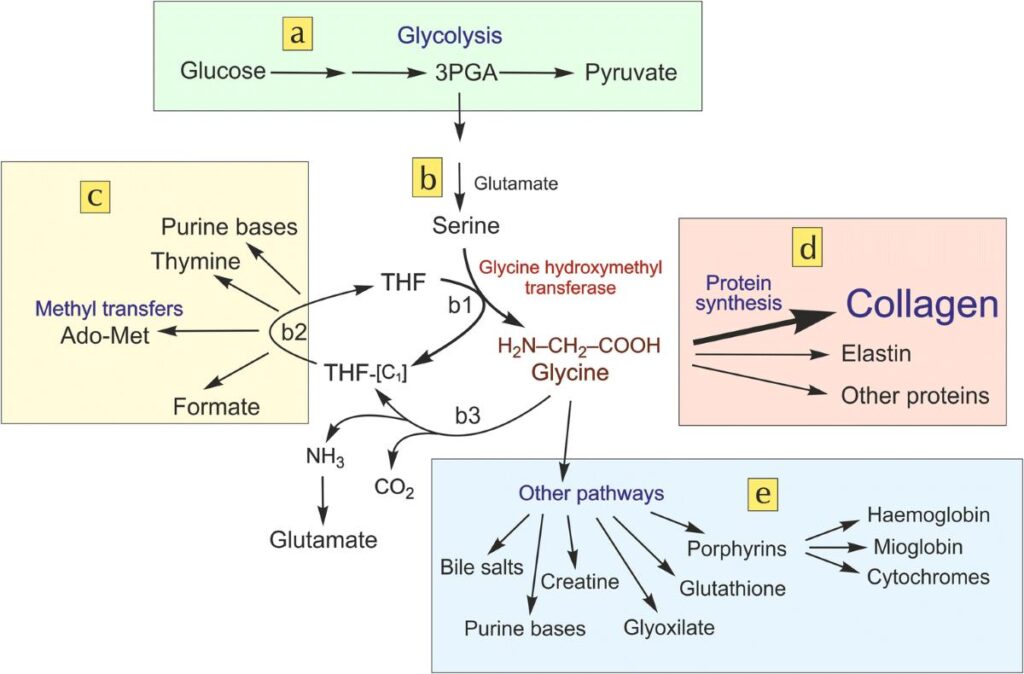
Glycine participates in:
- Protein synthesis
- Purine synthesis
- Heme formation
- Creatine synthesis
- Detoxification reactions
- Neurotransmission
- Collagen formation
- One-carbon metabolism
Structure and Properties of Glycine
| Property | Description |
|---|---|
| Chemical Formula | NH₂–CH₂–COOH |
| Molecular Weight | 75 Da |
| Type | Non-essential amino acid |
| Nature | Neutral, nonpolar |
| Side Chain | Hydrogen atom |
| Codons | GGU, GGC, GGA, GGG |
| Major Site of Synthesis | Liver |
Sources of Glycine
Dietary Sources
| Vegetarian Sources | Non-Vegetarian Sources |
|---|---|
| Soybean | Meat |
| Pulses | Fish |
| Nuts | Eggs |
| Seeds | Gelatin |
| Whole grains | Bone broth |
Since glycine is non-essential, the body can synthesize it even when dietary intake is low.
Biosynthesis of Glycine
Glycine is synthesized mainly in the liver from several precursors.
Major Precursors
| Precursor | Pathway |
|---|---|
| Serine | Major pathway |
| Threonine | Minor pathway |
| Choline | Via sarcosine |
| Hydroxyproline | Collagen metabolism |
Metabolism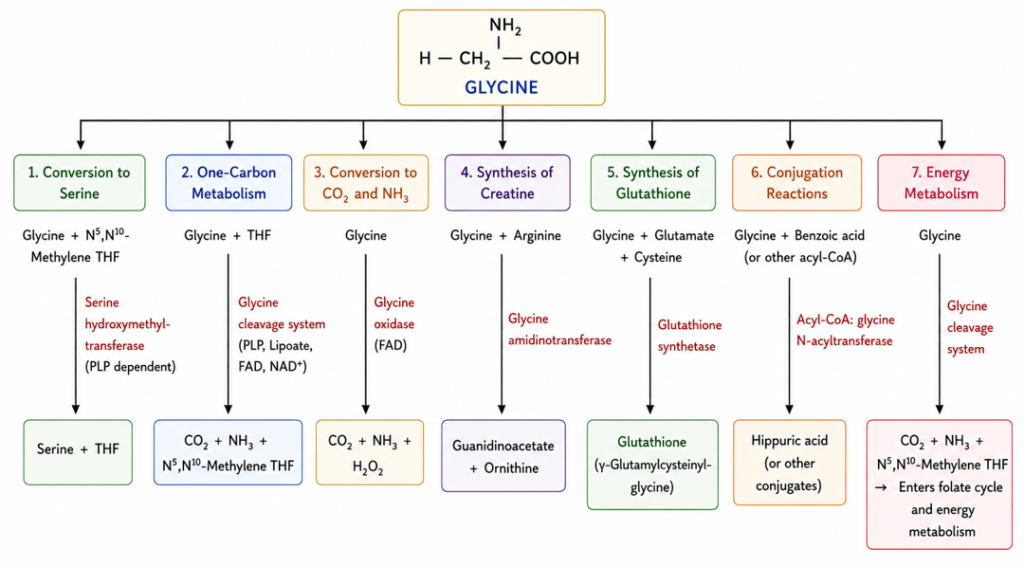
Degradation of Glycine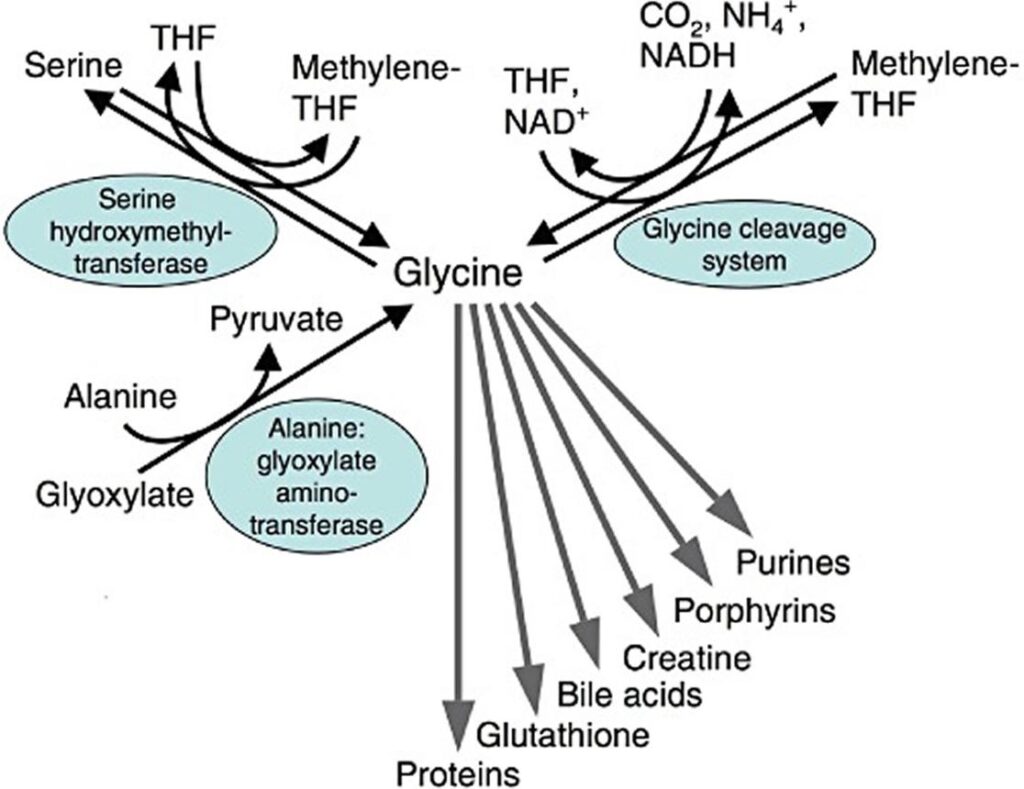
- Glycine is mainly degraded in the liver mitochondria.
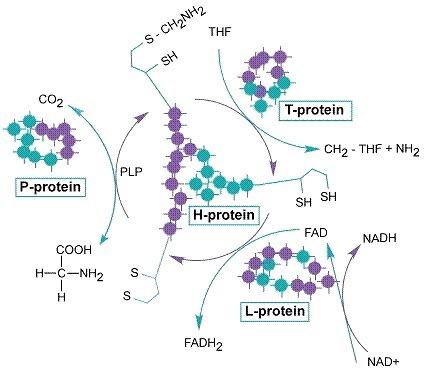
- The major pathway is the glycine cleavage system (GCS).
Reaction
Glycine + THF + NAD+ → CO2 + NH3 +N5,N10-methylene THF + NADH
Components of Glycine Cleavage System
| Component | Function |
|---|---|
| P-protein | Decarboxylation |
| H-protein | Carrier protein |
| T-protein | Transfers one-carbon unit |
| L-protein | Regenerates lipoamide |
Synthesis of Specialized Products from Glycine
1. Creatine Synthesis
Glycine combines with arginine to form guanidinoacetate, which is methylated to produce creatine.
Importance
- Energy storage in muscles
- Formation of creatine phosphate
Reaction
Glycine + Arginine → Guanidinoacetate → Creatine
2. Porphyrin (Heme) Synthesis
Glycine combines with succinyl-CoA to form δ-aminolevulinic acid (ALA), the first step in heme synthesis.
Importance
- Hemoglobin formation
- Cytochromes synthesis
Reaction
Glycine + Succinyl-CoA → δ-ALA
3. Purine Synthesis
Glycine contributes carbon and nitrogen atoms to the purine ring.
Importance
- DNA and RNA synthesis
- ATP formation
Contribution
- C4, C5, and N7 atoms of purine ring are derived from glycine.
4. Glutathione Synthesis
Glycine combines with glutamate and cysteine to form glutathione.
Importance
- Antioxidant defense
- Detoxification
5. Bile Salt Formation
Glycine conjugates with bile acids to form bile salts.
Examples
| Bile Acid | Glycine Conjugate |
|---|---|
| Cholic acid | Glycocholic acid |
Importance
- Fat digestion and absorption
6. Hippuric Acid Formation
Glycine conjugates with benzoic acid to form hippuric acid.
Importance
- Detoxification reaction
- Excretion of toxic compounds
Reaction
Benzoic acid + Glycine → Hippuric acid
Metabolic Functions of Glycine
1. Role in Protein Synthesis
Glycine is an important constituent of:
- Collagen
- Elastin
- Enzymes
- Structural proteins
Glycine in Collagen
Every third amino acid in collagen is glycine.
Importance
- Provides flexibility
- Stabilizes triple helix structure
2. Role in Purine Synthesis
Glycine contributes carbon and nitrogen atoms in purine ring formation.
Contribution to Purine Ring
| Atom in Purine Ring | Source |
|---|---|
| C4 | Glycine |
| C5 | Glycine |
| N7 | Glycine |
Clinical Importance
Purines are required for:
- DNA synthesis
- RNA synthesis
- ATP formation
3. Role in Heme Synthesis
Glycine combines with succinyl-CoA to form δ-aminolevulinic acid (ALA).
Reaction
Glycine + Succinyl-CoA → δ-ALA
Enzyme
ALA synthase
Coenzyme
Pyridoxal phosphate (Vitamin B₆)
4. Role in Creatine Synthesis
Creatine is synthesized from:
- Glycine
- Arginine
- Methionine
Functions of Creatine
- Energy storage in muscles
- ATP regeneration
5. Role in Detoxification
Glycine participates in conjugation reactions.
Examples
| Toxic Substance | Glycine Conjugate |
|---|---|
| Benzoic acid | Hippuric acid |
| Salicylic acid | Salicyluric acid |
This helps detoxification and excretion.
6. Neurotransmitter Function
Glycine acts as an inhibitory neurotransmitter in:
- Spinal cord
- Brain stem
- Retina
Mechanism
- Opens chloride channels
- Causes hyperpolarization
- Inhibits neuronal activity
7. Role in Glutathione Synthesis
Glutathione is composed of:
- Glutamate
- Cysteine
- Glycine
Importance of Glutathione
- Antioxidant defense
- Detoxification
- Protection from oxidative stress
Regulation
| Regulatory Factor | Effect |
|---|---|
| Vitamin B₆ | Required for SHMT activity |
| Folate | Accepts one-carbon units |
| NAD⁺ availability | Influences glycine cleavage |
| Liver function | Major determinant |
| Mitochondrial function | Required for cleavage system |
Metabolic Disorders of Glycine
1. Nonketotic Hyperglycinemia (NKH)
- Caused by defect in the glycine cleavage system
- Leads to accumulation of glycine in blood and cerebrospinal fluid
Clinical Features
- Seizures
- Mental retardation
- Hypotonia
- Developmental delay
- Respiratory distress
2. Hyperoxaluria and Renal Stones
Defect in glyoxylate metabolism increases oxalate formation.
Result
- Calcium oxalate kidney stones
- Nephrocalcinosis
- Renal failure in severe cases
3. Role in Heme Synthesis
Glycine is required for synthesis of heme.
Clinical Importance
Deficiency may impair:
- Hemoglobin synthesis
- Cytochrome formation
This can contribute to certain types of anemia.
Reaction
Glycine + Succinyl-CoA → δ-ALA
4. Neurological Importance
Glycine acts as an inhibitory neurotransmitter in:
- Spinal cord
- Brain stem
Abnormal glycine levels may cause:
- Convulsions
- Neurological dysfunction
- Cognitive impairment
5. Antioxidant Defense
Glycine is required for glutathione synthesis.
Importance
Glutathione protects cells from:
- Oxidative stress
- Free radical injury
- Cellular damage
6. Detoxification Reactions
Glycine conjugates toxic compounds to form harmless products.
Example
Benzoic acid + Glycine → Hippuric acid
Importance
- Detoxification in liver
- Excretion of toxic substances in urine
7. Role in Purine Synthesis
Glycine contributes to purine ring formation.
Clinical Importance
Essential for:
- DNA synthesis
- Cell division
- Rapidly growing tissues
8. Vitamin B₆ and Folate Deficiency
Vitamin B₆ and tetrahydrofolate are required for glycine metabolism.
Deficiency Leads To
- Impaired amino acid metabolism
- Increased oxalate excretion
- Defective nucleotide synthesis