Introduction
- Phospholipids are a major group of complex lipids.
- They play a central role in the structure and function of living cells.
- They are especially important because they form the basic framework of biological membranes.
- Unlike storage lipids such as triacylglycerols, phospholipids are mainly involved in:
- Structural functions
- Regulatory functions
- They are present in:
- Plasma membranes
- Membranes surrounding intracellular organelles

- The special behavior of phospholipids is due to their amphipathic nature.
- Each molecule contains:
- A water-attracting region
- A water-repelling region
- When phospholipids are placed in an aqueous environment:
- They organize themselves into structures.
- These structures minimize contact between their hydrophobic portions and water.
- This property is fundamental to the formation of cell membranes.
- Phospholipids also participate in:
- Lipid transport
- Cell signaling
- Blood coagulation
- Nerve function
- Pulmonary surfactant activity
Structure of Phospholipids
The structure of a phospholipid can be understood by dividing it into two major regions:
1. Hydrophilic Head
- The head contains the phosphate-containing polar region.
- It also contains its attached substituent.
- It interacts readily with water.
2. Hydrophobic Region
- The hydrophobic portion is usually formed by long hydrocarbon chains derived from fatty acids.
- It avoids water.
Simple Representation
Hydrophilic head + Hydrophobic tails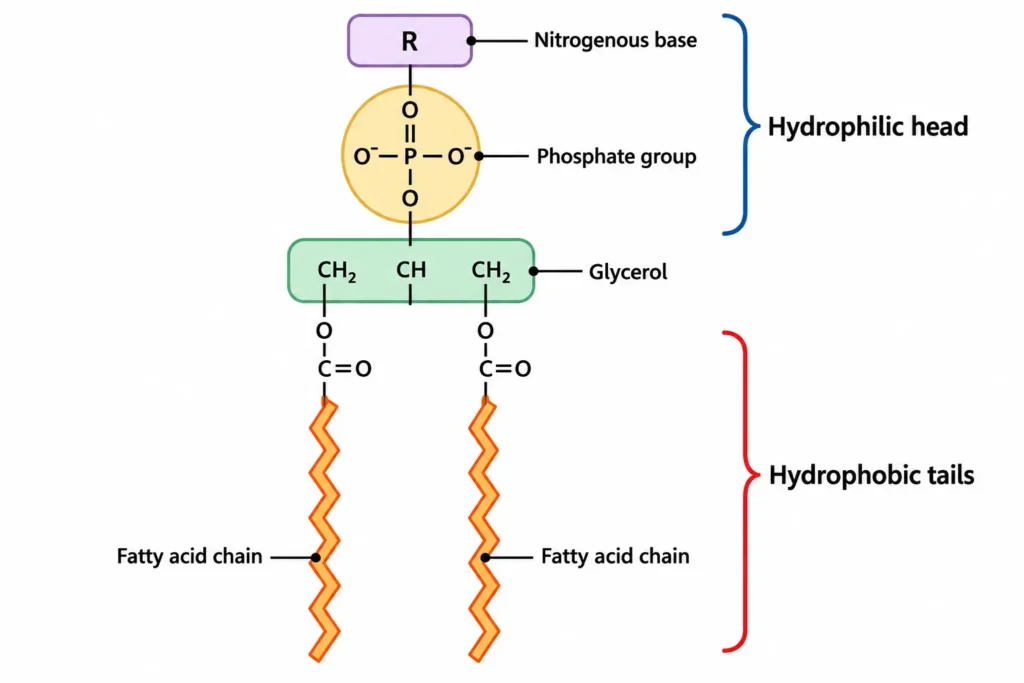
- This arrangement gives phospholipids their characteristic amphipathic behavior.
Amphipathic Nature
- The term amphipathic means that a molecule possesses both hydrophilic and hydrophobic regions.
In Phospholipids
- The phosphate-containing head is predominantly hydrophilic.
- The fatty acid-derived hydrocarbon chains are hydrophobic.
Behavior in Water
- When phospholipids are surrounded by water:
- The hydrophilic portions tend to remain in contact with water.
- The hydrophobic portions are shielded from water.
- This behavior leads to the spontaneous formation of organized lipid structures.
- The most important of these is the phospholipid bilayer.
- The phospholipid bilayer forms the foundation of biological membranes.
- Phospholipids can also participate in the formation of:
- Liposomes
- Other lipid aggregates
Classification
Phospholipids can broadly be divided according to the type of alcohol present in their structure.
1. Glycerophospholipids
- These contain glycerol as their backbone.
- They are major components of biological membranes.
Examples
- Phosphatidic acid
- Phosphatidylcholine
- Phosphatidylethanolamine
- Phosphatidylserine
- Phosphatidylinositol
- Cardiolipin
2. Sphingophospholipids
- These contain sphingosine rather than glycerol as their basic backbone.
Major Example
- Sphingomyelin
- Both groups are important.
- Their structures and distribution within tissues differ.
Glycerophospholipids
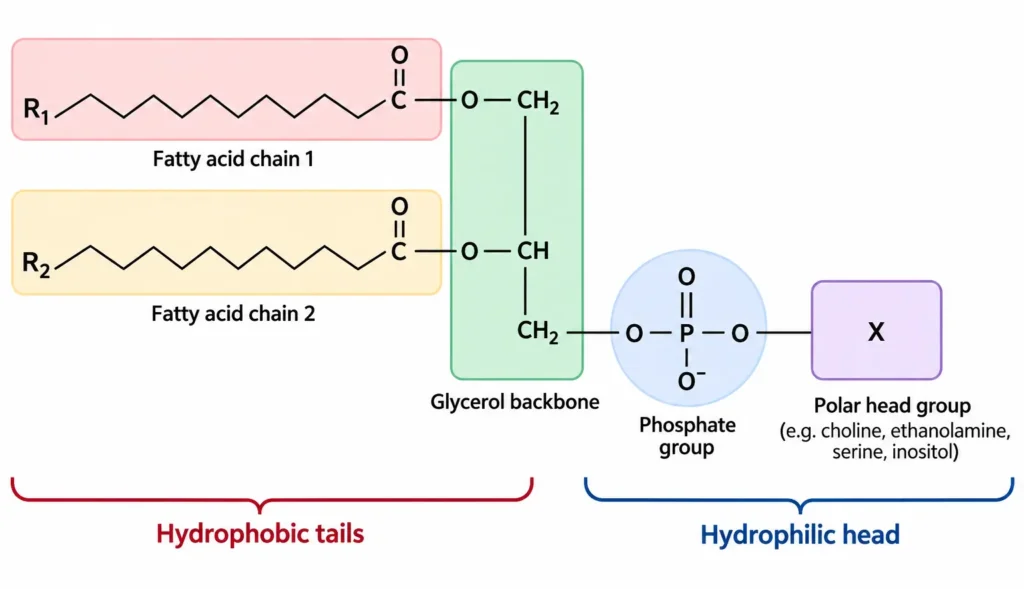
- Glycerophospholipids are phospholipids built around a glycerol molecule.
Typical Structure
- Two fatty acid residues are attached to glycerol.
- A phosphate group is attached to the remaining hydroxyl group.
- The phosphate is linked to a specific polar head group.
- The identity of the head group determines the particular glycerophospholipid.
Examples of Head Groups
- Choline
- Ethanolamine
- Serine
- Inositol
Phosphatidic Acid
- Phosphatidic acid is the simplest important glycerophospholipid.
- It serves as a central intermediate in phospholipid metabolism.
Composition
It consists essentially of:
- Glycerol
- Two fatty acid residues
- Phosphate
Importance
- Phosphatidic acid can serve as a precursor for the synthesis of several other glycerophospholipids.
- It is also an intermediate in the synthesis of triacylglycerols.
- Therefore, phosphatidic acid occupies an important position at the intersection of:
- Phospholipid metabolism
- Neutral-lipid metabolism
Phosphatidylcholine
- Phosphatidylcholine is one of the most abundant phospholipids in many animal cell membranes.
- It is commonly known as lecithin in biochemical and nutritional contexts.
- Its polar head group contains choline.
Major Locations
Phosphatidylcholine is found in:
- Plasma membranes
- Intracellular membranes
- Lipoproteins
- Liver
- Nervous tissue
- Pulmonary surfactant
Important Functions
Membrane structure
- It contributes significantly to the organization and physical properties of cell membranes.
Lipid transport
- It is an important component of plasma lipoproteins.
- It helps package and transport lipids in the circulation.
Pulmonary surfactant
- A particularly important molecular species is dipalmitoylphosphatidylcholine (DPPC).
- It is a major component of pulmonary surfactant.
- It helps reduce surface tension within the alveoli.
Bile
- Phosphatidylcholine is an important phospholipid in bile.
- It contributes to the solubilization of cholesterol.
Pulmonary Surfactant and Phosphatidylcholine
- The alveoli of the lungs are lined by a thin fluid layer.
- Surface tension at the air-liquid interface can cause the alveoli to collapse.
- Pulmonary surfactant reduces this surface tension.
- DPPC is one of the major surface-active phospholipids in pulmonary surfactant.
Effects of DPPC
It helps to:
- Reduce alveolar surface tension
- Maintain alveolar stability
- Reduce the tendency of alveoli to collapse
Respiratory Distress Syndrome
- Premature infants may have insufficient production of pulmonary surfactant.
- This may occur because the lungs have not fully matured.
- Surfactant deficiency can result in neonatal respiratory distress syndrome.
- It is characterized by difficulty maintaining normal alveolar expansion.
Assessment of Fetal Lung Maturity
- Assessment of fetal lung maturity has historically included measurement of phospholipid components in amniotic fluid.
- This includes the lecithin-to-sphingomyelin ratio.
- Modern clinical assessment may use additional biochemical and clinical methods.
Phosphatidylethanolamine
- Phosphatidylethanolamine contains ethanolamine as its polar head group.
- It is an important membrane phospholipid.
- It is particularly significant in maintaining:
- Physical properties of biological membranes
- Organization of biological membranes
Functions
- Contributes to membrane structure
- Influences membrane curvature
- Participates in membrane protein interactions
- Helps maintain membrane organization
- Occurs in nervous and other tissues
- Phosphatidylethanolamine is also involved in several metabolic pathways within cells.
Phosphatidylserine
- Phosphatidylserine contains serine as its polar head group.
- It is normally concentrated mainly on the inner leaflet of the plasma membrane.
- Its distribution can change during cellular processes.
Functions
- Helps maintain membrane structure
- Participates in cell signaling
- Contributes to blood coagulation
- Plays an important role in apoptosis
During Apoptosis
- During apoptosis, phosphatidylserine becomes exposed on the outer surface of the plasma membrane.
- This acts as an important recognition signal for cells that remove dying cells.
In Blood Coagulation
- Phosphatidylserine exposure on activated platelets contributes to the assembly of coagulation complexes.
Phosphatidylinositol
- Phosphatidylinositol contains inositol as its polar head group.
- It represents a relatively small fraction of total membrane phospholipids.
- Despite this, it has an important role in cellular communication.
Phosphoinositides
- Phosphatidylinositol can be phosphorylated at different positions of the inositol ring.
- This produces various phosphoinositides.
Functions of Phosphoinositides
They regulate:
- Cell signaling
- Membrane trafficking
- Cell growth
- Cell movement
- Cytoskeletal organization
Important Signaling Pathway
Certain phosphoinositides can be broken down to generate:
- Inositol 1,4,5-trisphosphate (IP₃)
- Diacylglycerol (DAG)
Functions of IP₃ and DAG
- IP₃ promotes the release of calcium from intracellular stores.
- DAG participates in activation of protein kinase C.
Cardiolipin
- Cardiolipin is a specialized phospholipid with a distinctive structure.
- It is particularly abundant in the inner mitochondrial membrane.
- Unlike most glycerophospholipids, cardiolipin contains two phosphatidate units linked through a glycerol bridge.
Functions
Cardiolipin is important for:
- Mitochondrial membrane organization
- Electron transport chain function
- Oxidative phosphorylation
- Organization of respiratory-chain complexes
- Maintenance of mitochondrial membrane integrity
- Mitochondria depend heavily on their inner membrane for ATP production.
- Therefore, cardiolipin is important for efficient cellular energy metabolism.
Clinical and Laboratory Relevance
- Cardiolipin is relevant to laboratory medicine.
- Anticardiolipin antibodies are associated with antiphospholipid syndrome.
- Cardiolipin-related reagents have also historically been used in serological testing for syphilis.
- Examples include:
- VDRL
- RPR
Sphingophospholipids
- Sphingophospholipids differ from glycerophospholipids.
- Their backbone is derived from sphingosine rather than glycerol.
- The principal sphingophospholipid is sphingomyelin.
Sphingomyelin
- Sphingomyelin is composed of:
- Sphingosine
- A fatty acid
- Phosphoric acid
- Choline
Ceramide Unit
- The sphingosine and fatty acid together form a ceramide unit.
- Addition of a phosphorylcholine group produces sphingomyelin.
Distribution
Sphingomyelin is particularly abundant in:
- Nervous tissue
- Myelin
- Plasma membranes
- Brain tissue
Functions
Sphingomyelin contributes to:
- Membrane structure
- Membrane organization
- Formation of myelin
- Electrical insulation of nerve fibers
- The myelin sheath surrounding many nerve fibers helps increase the efficiency and speed of electrical impulse conduction.
Niemann-Pick Disease
- Sphingomyelin metabolism has important clinical significance.
- In some forms of Niemann-Pick disease, particularly types A and B:
- Deficiency of acid sphingomyelinase occurs.
- Breakdown of sphingomyelin is impaired.
- As a result:
- Sphingomyelin accumulates in cells.
- Accumulation occurs particularly within the lysosomal compartment.
Manifestations
Depending on the specific type and severity, manifestations may include:
- Enlargement of the liver and spleen
- Neurological abnormalities
- Developmental impairment
- Progressive organ dysfunction
- This condition demonstrates the importance of normal phospholipid degradation in maintaining cellular health.
Biological Functions of Phospholipids
1. Structural Role
- Phospholipids are fundamental structural components of biological membranes.
- They are present in membranes surrounding:
- Cells
- Nuclei
- Mitochondria
- Endoplasmic reticulum
- Golgi apparatus
- Lysosomes
- The membrane:
- Provides a boundary between different cellular compartments.
- Helps control the movement of substances.
2. Formation of the Lipid Bilayer
- The amphipathic nature of phospholipids allows them to form a bilayer in water.
- The hydrophobic tails face toward the interior.
- The hydrophilic heads face the surrounding aqueous environment.
- This bilayer forms the basic structural framework of the fluid mosaic model of biological membranes.
- Membrane proteins, cholesterol, glycolipids, and other components are embedded within or associated with this lipid environment.
3. Cell Signaling
- Some phospholipids serve as precursors for signaling molecules.
- Phosphatidylinositol and its phosphorylated derivatives participate in signaling pathways.
- These pathways can be triggered by:
- Hormones
- Growth factors
- Neurotransmitters
- Other extracellular signals
- Phospholipids can therefore:
- Act as structural molecules.
- Help convert an external signal into an intracellular response.
4. Blood Coagulation
- Certain negatively charged phospholipids, particularly phosphatidylserine, become exposed on the surface of activated platelets.
- This creates a suitable surface for the assembly of several coagulation factor complexes.
- Therefore, phospholipids contribute to normal:
- Hemostasis
- Blood clot formation
5. Pulmonary Surfactant
- Phospholipids, especially DPPC, are major components of pulmonary surfactant.
- They reduce surface tension at the alveolar air-liquid interface.
- They help maintain normal lung function.
6. Lipid Transport
- Phospholipids are important structural components of plasma lipoproteins.
- They form part of the outer surface of:
- Chylomicrons
- VLDL
- LDL
- HDL
- This arrangement:
- Helps package hydrophobic lipids.
- Allows them to be transported through the aqueous bloodstream.
7. Lipid Digestion and Emulsification
- Phospholipids such as phosphatidylcholine can contribute to the emulsification and solubilization of lipids in the digestive system.
- Together with:
- Bile salts
- Other components of bile
- They facilitate:
- Processing of dietary lipids
- Digestion of lipids
- Absorption of lipids
8. Nervous System Function
- Phospholipids are major components of neuronal membranes.
- Sphingomyelin is especially abundant in myelin.
- It contributes to the insulating properties of the myelin sheath.
- This supports efficient transmission of electrical signals along nerve fibers.
Clinical Significance
Phospholipids are associated with several important clinical conditions.
1. Respiratory Distress Syndrome
- Insufficient pulmonary surfactant, particularly in premature newborns, can cause respiratory distress.
- This occurs because the alveoli are difficult to keep open.
2. Niemann-Pick Disease
- Defective sphingomyelin degradation can cause sphingomyelin accumulation in cells.
- It can produce:
- Systemic abnormalities
- Neurological abnormalities
3. Antiphospholipid Syndrome
- Autoantibodies against phospholipid-binding protein complexes, including those detected by anticardiolipin antibody testing, are associated with antiphospholipid syndrome.
- This disorder is characterized by:
- An increased tendency toward thrombosis
- Certain pregnancy complications
4. Gallstone Formation
- Phosphatidylcholine is an important component of bile.
- It contributes to cholesterol solubilization.
- Disturbances in the balance among:
- Cholesterol
- Bile salts
- Phospholipids
- Can promote:
- Cholesterol crystallization
- Gallstone formation