Introduction
- The human body needs energy for important activities such as movement, brain function, growth, and cell maintenance.
- Glucose is an important source of energy, especially for the brain and red blood cells.
- The body does not use all available glucose immediately.
- When glucose is present in excess, especially after a meal, it is converted into glycogen for storage.
- The process of converting glucose into glycogen is called glycogenesis.
- Glycogenesis helps the body store glucose and provide energy when needed.
- It is especially important between meals and during periods of increased energy demand.
- Glycogenesis occurs mainly in the liver and skeletal muscles.
- The liver stores glycogen mainly to help maintain blood glucose levels, while muscles store it mainly for their own energy needs.
Major Sites of Glycogenesis
1. Liver
- The liver plays an important role in maintaining blood glucose concentration.
- After a meal, when blood glucose levels are high, the liver takes up glucose and converts it into glycogen.
- During fasting, liver glycogen can be broken down and the resulting glucose can contribute to maintaining blood glucose levels.
- Therefore, liver glycogen primarily serves as a buffer for blood glucose concentration.
2. Skeletal Muscle
- Skeletal muscles also store considerable amounts of glycogen.
- However, muscle glycogen has a different primary function. It is mainly used as a local energy source during muscle contraction and exercise.
- Muscle glycogen generally cannot directly supply free glucose to the bloodstream because skeletal muscle lacks significant glucose-6-phosphatase activity.
Steps of Glycogenesis
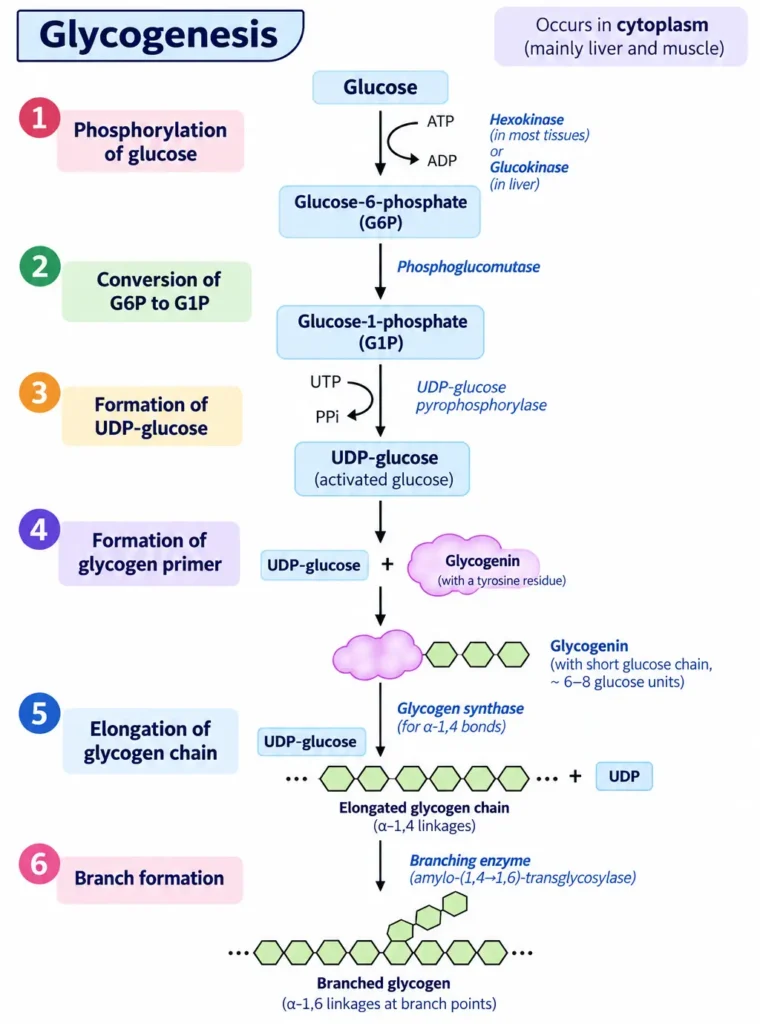
Glycogenesis involves several sequential reactions. The major steps are described below.
Step 1: Phosphorylation of Glucose
- The first step is the conversion of glucose into glucose-6-phosphate.
Glucose + ATP → Glucose-6-phosphate + ADP
This reaction is catalyzed by:
-
- Hexokinase in most tissues
- Glucokinase mainly in the liver
- This phosphorylation traps glucose inside the cell because glucose-6-phosphate cannot easily cross the cell membrane.
- Hexokinase has a high affinity for glucose and functions effectively even when glucose concentration is relatively low.
- Glucokinase is found mainly in liver cells and pancreatic β-cells and has a lower affinity but higher capacity for glucose. This makes it particularly useful after carbohydrate-rich meals when blood glucose is elevated.
Step 2: Conversion of Glucose-6-Phosphate to Glucose-1-Phosphate
- Glucose-6-phosphate is converted into glucose-1-phosphate.
Glucose-6-phosphate ⇌ Glucose-1-phosphate
- The enzyme responsible for this reaction is phosphoglucomutase.
- This reaction is reversible and prepares glucose for activation before it is incorporated into glycogen.
Step 3: Formation of UDP-Glucose
- Glucose-1-phosphate is activated by reacting with UTP to form UDP-glucose.
Glucose-1-phosphate + UTP → UDP-glucose + PPi
- The enzyme involved is UDP-glucose pyrophosphorylase.
- UDP-glucose is an activated glucose donor and provides glucose units for glycogen synthesis.
- The breakdown of pyrophosphate (PPi) helps drive this reaction forward.
Step 4: Formation of the Glycogen Primer
- Glycogen synthesis cannot begin simply by adding glucose molecules to nothing. A short glucose chain called a primer is required.
- The protein glycogenin acts as the starting point for glycogen synthesis.
- Glycogenin attaches the first glucose molecule to a specific tyrosine residue on itself and then adds several additional glucose molecules.
- This short chain serves as the primer for glycogen synthase.
Step 5: Elongation of the Glycogen Chain
- Once the primer has been formed, glycogen synthase adds glucose molecules from UDP-glucose to the growing glycogen chain.
- The enzyme forms α-1,4 glycosidic bonds between glucose molecules.
- UDP-glucose + glycogen → elongated glycogen + UDP
- Glycogen synthase is one of the most important regulatory enzymes in glycogenesis.
- However, glycogen synthase cannot create branch points. Branching requires a separate enzyme.
Step 6: Branch Formation
- The branching enzyme, also known as amylo-(1,4→1,6)-transglycosylase, introduces branches into the glycogen molecule.
- It transfers a segment of glucose residues from a growing chain and attaches it through an α-1,6 glycosidic bond.
- This produces the characteristic highly branched structure of glycogen.
- Branch formation is important because it:
- Increases glycogen solubility.
- Provides many sites for further glucose addition.
- Allows rapid glycogen synthesis.
- Allows rapid glycogen breakdown when glucose is needed.
Regulation
1. Regulation by Insulin
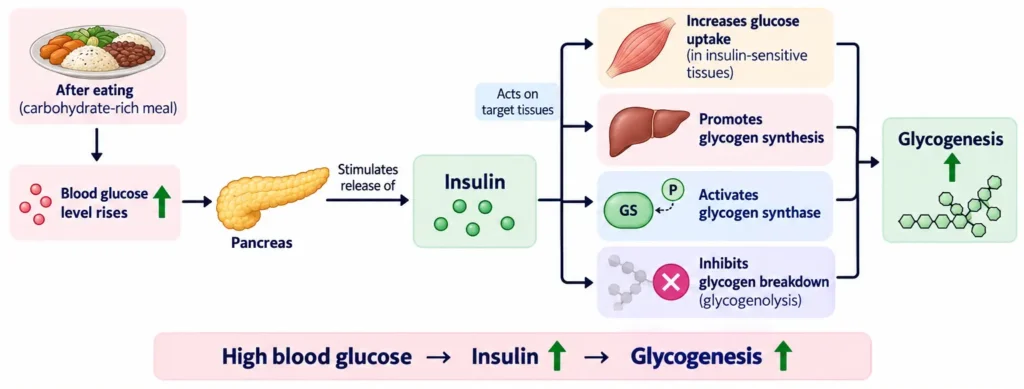
- After a meal, blood glucose levels increase.
- The pancreas releases insulin.
- Insulin promotes the uptake of glucose into cells.
- It activates glycogen synthase, the main enzyme involved in glycogen formation.
- As a result, more glucose is converted into glycogen and stored.
- Insulin also reduces glycogen breakdown.
High blood glucose → Insulin ↑ → Glycogenesis ↑
2. Regulation by Glucagon
- During fasting, blood glucose levels decrease.
- The pancreas releases glucagon.
- Glucagon reduces glycogen synthesis, mainly in the liver.
- It promotes glycogen breakdown (glycogenolysis) to help maintain blood glucose.
Low blood glucose → Glucagon ↑ → Glycogenesis ↓
3. Regulation by Adrenaline
- Adrenaline is released during exercise, stress, or emergencies.
- It decreases glycogen synthesis.
- It mainly promotes glycogen breakdown to provide energy quickly.
4. Role of Glycogen Synthase
- Glycogen synthase is the key enzyme responsible for adding glucose units to glycogen.
- When glycogen synthase is active, glycogenesis increases.
- Insulin helps activate glycogen synthase.
- Glucagon and adrenaline promote its inactivation.
Glycogenesis During the Fed and Fasting States
The activity of glycogenesis changes according to nutritional status.
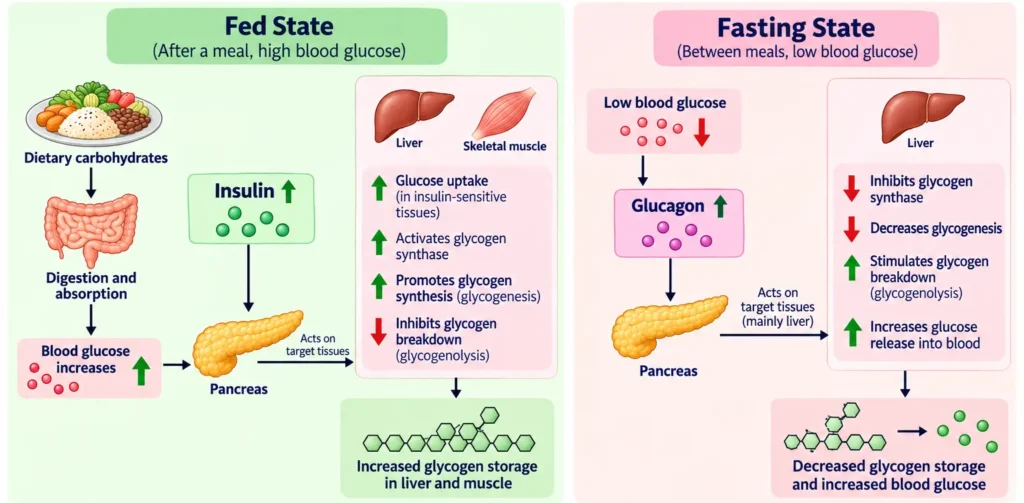
Glycogenesis in Liver vs. Muscle
Although glycogenesis occurs in both liver and skeletal muscle, the functions of glycogen are different.
| Feature | Liver | Skeletal Muscle |
|---|---|---|
| Main purpose | Helps maintain blood glucose | Provides energy for muscle |
| Major storage role | Blood glucose regulation | Local energy reserve |
| Responds strongly to insulin | Yes | Yes |
| Significant response to glucagon | Yes | No |
| Glucose-6-phosphatase | Present | Essentially absent |
| Glycogen used mainly for | Maintaining blood glucose | Muscle activity |
This difference is important when studying carbohydrate metabolism.
Importance of Glycogenesis
Glycogenesis has several important functions in the body.
1. Stores Excess Glucose
- After eating, the amount of glucose in the blood increases.
- The body converts some of this extra glucose into glycogen, which is stored mainly in the liver and skeletal muscles.
2. Helps Maintain Blood Glucose
- Glycogen stored in the liver acts as a glucose reserve.
- Between meals, when blood glucose levels start to fall, liver glycogen can be broken down to help maintain normal blood glucose levels.
3. Provides Energy to Muscles
- Skeletal muscles store glycogen for their own energy needs.
- During exercise or physical activity, muscle glycogen can be broken down to provide glucose for energy production.
4. Provides a Quick Energy Reserve
- Glycogen can be stored and broken down relatively quickly.
- This makes it a useful short-term energy reserve when the body suddenly needs more energy.
5. Prevents Excess Glucose Accumulation
- Converting glucose into glycogen helps prevent excessive amounts of free glucose from accumulating inside cells.
- Glycogen allows many glucose molecules to be stored together in a compact form.
6. Helps Maintain Energy Balance
- Glycogenesis is especially active after a meal when glucose is readily available.
- Insulin stimulates glycogenesis, encouraging the body to store glucose rather than leaving excess glucose in the blood.
7. Supports Normal Carbohydrate Metabolism
- Glycogenesis works together with glycogenolysis and other pathways of glucose metabolism.
- This allows the body to store glucose when it is abundant and make use of stored glucose when it is required.