Introduction
- The urea cycle, also known as the Krebs–Henseleit cycle, is one of the most important metabolic pathways in the human body.
- It is responsible for converting toxic ammonia into urea, which can then be safely excreted through urine. Ammonia is continuously produced during the breakdown of amino acids and proteins.
- Since ammonia is highly toxic, especially to the brain and nervous system, the body must rapidly remove it to maintain normal physiological functions.
- The urea cycle mainly occurs in the liver and plays a major role in nitrogen metabolism.
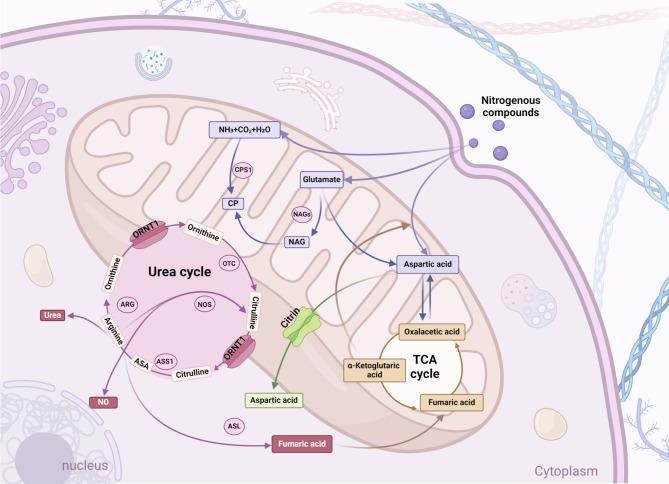
- It is considered the primary pathway for detoxification of ammonia in humans. The cycle was first described by Hans Krebs and Kurt Henseleit in 1932, and therefore it is named the Krebs–Henseleit cycle.
- This cycle is essential for survival because accumulation of ammonia in the blood leads to hyperammonemia, which can cause neurological disturbances, coma, and even death.
- The urea cycle is closely connected with amino acid metabolism, the tricarboxylic acid (TCA) cycle, and energy metabolism.
Site of Urea Cycle
The urea cycle occurs mainly in the liver.
Cellular Location
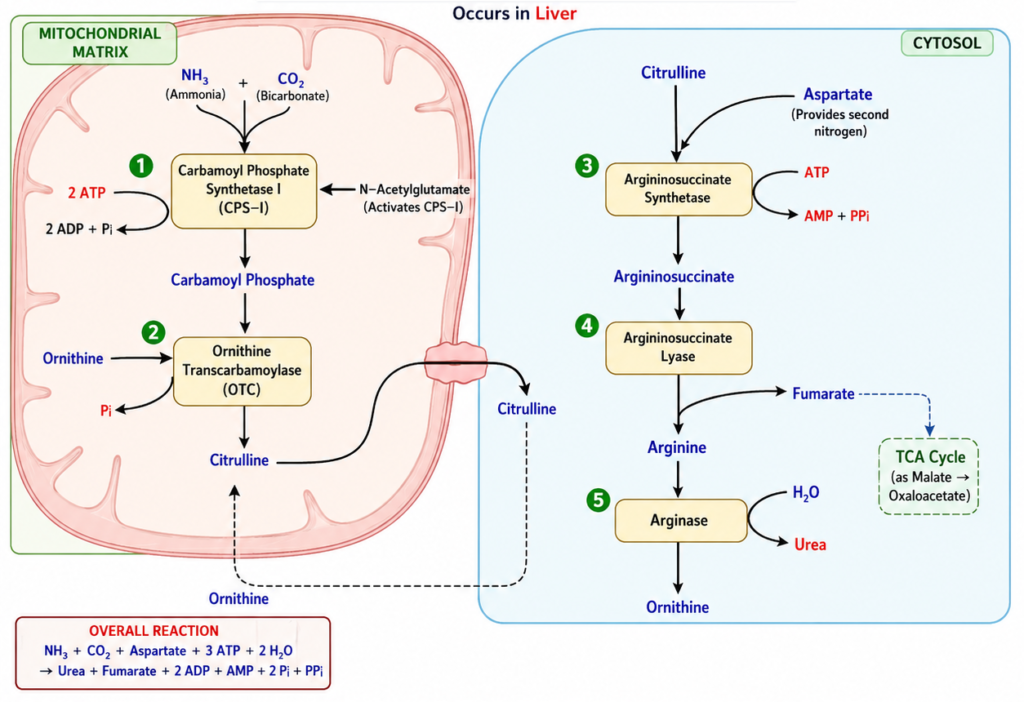
The reactions are divided between:
| Location | Reactions |
|---|---|
| Mitochondria | First two reactions |
| Cytoplasm | Remaining three reactions |
Thus, both mitochondrial and cytosolic enzymes are required for completion of the cycle.
Importance of Urea Cycle
The urea cycle has several important physiological functions:
- Detoxification of ammonia
- Maintenance of nitrogen balance
- Removal of excess nitrogen from amino acid catabolism
- Prevention of hyperammonemia
- Regulation of acid-base balance
- Connection with TCA cycle through fumarate formation
Sources of Ammonia
Ammonia used in the urea cycle is produced from several sources:
- Amino acid deamination – Major source during protein metabolism.
- Transdeamination – Transfer of amino groups to glutamate followed by ammonia release.
- Deamidation of glutamine and asparagine – Produces free ammonia.
- Intestinal bacteria – Bacterial urease converts urea into ammonia.
- Purine and pyrimidine breakdown – Releases ammonia during nucleic acid metabolism.
- Biogenic amine metabolism – Breakdown of neurotransmitters forms ammonia.
- Muscle activity – Exercise increases ammonia production from amino acids.
- Kidney metabolism – Ammonia produced from glutamine helps in acid-base balance.
Urea Cycle
The cycle consists of five major enzymatic reactions.
Features
- Occurs only in liver
- Requires ATP
- Produces urea
- Uses ammonia and carbon dioxide
- Connected to TCA cycle
Steps of Urea Cycle
Step 1: Formation of Carbamoyl Phosphate
In the mitochondria, ammonia combines with carbon dioxide to form carbamoyl phosphate.
Enzyme
Carbamoyl phosphate synthetase I (CPS-I)
Reaction
NH3 + CO2 + 2ATP → Carbamoyl phosphate+2ADP+Pi
Important Points
- Rate-limiting step
- Requires 2 ATP
- Requires activator N-acetylglutamate
- Occurs in mitochondria
Step 2: Formation of Citrulline
Carbamoyl phosphate transfers its carbamoyl group to ornithine forming citrulline.
Enzyme
Ornithine transcarbamoylase (OTC)
Reaction
Carbamoyl phosphate + Ornithine → Citrulline + Pi
Important Points
- Occurs in mitochondria
- Citrulline moves to cytoplasm
Step 3: Formation of Argininosuccinate
Citrulline combines with aspartate to form argininosuccinate.
Enzyme
Argininosuccinate synthetase
Reaction
Citrulline + Aspartate + ATP → Argininosuccinate + AMP + PPi
Important Points
- Aspartate provides second nitrogen atom of urea
- Requires ATP
Step 4: Cleavage of Argininosuccinate
Argininosuccinate is cleaved into arginine and fumarate.
Enzyme
Argininosuccinate lyase
Reaction
Argininosuccinate → Arginine + Fumarate
Important Points
- Fumarate enters TCA cycle
- Links urea cycle with energy metabolism
Step 5: Formation of Urea
Arginine is hydrolyzed to produce urea and ornithine.
Enzyme
Arginase
Reaction
Arginine + H2O → Urea + Ornithine
Important Points
- Ornithine returns to mitochondria
- Cycle repeats again
Energy Requirement of Urea Cycle
The urea cycle requires significant energy.
ATP Consumption
- 2 ATP used in carbamoyl phosphate formation
- 1 ATP used in argininosuccinate synthesis
Although only 3 ATP molecules are used, a total of 4 high-energy phosphate bonds are consumed because ATP is converted to AMP in one step.
Regulation of Urea Cycle
The urea cycle is tightly regulated according to the body’s nitrogen load.
| Regulatory Factor | Mechanism | Effect on Urea Cycle |
|---|---|---|
| N-Acetylglutamate (NAG) | Activates Carbamoyl Phosphate Synthetase-I (CPS-I) | Increases urea cycle activity |
| Carbamoyl Phosphate Synthetase-I (CPS-I) | Rate-limiting enzyme of cycle | Controls overall rate of urea synthesis |
| Arginine | Stimulates formation of NAG | Enhances urea cycle |
| High Protein Diet | Increases amino acid breakdown and ammonia production | Increases enzyme synthesis and urea formation |
| Starvation/Fasting | Increases protein catabolism | Increases ammonia production and urea synthesis |
| Glucagon | Promotes protein breakdown | Stimulates urea formation |
| Cortisol | Enhances amino acid catabolism | Increases urea cycle activity |
| Substrate Availability | Increased ammonia and aspartate supply | Enhances urea production |
Connection with TCA Cycle
The urea cycle is connected to the TCA cycle through fumarate.
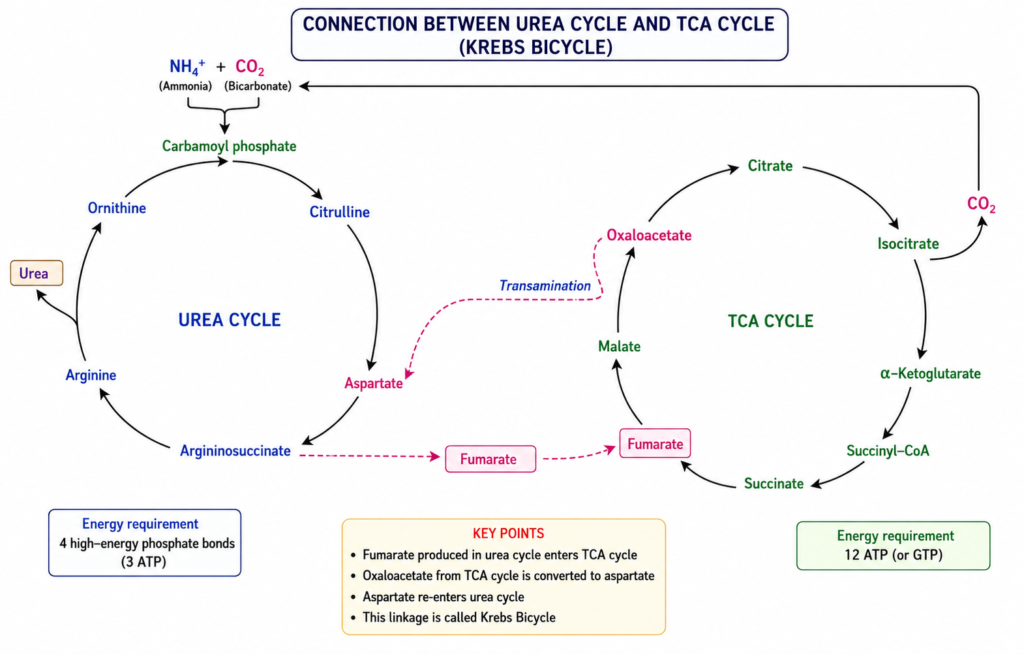
Oxaloacetate can then form aspartate, which re-enters the urea cycle.
| Urea Cycle Intermediate | Connection with TCA Cycle | Importance |
|---|---|---|
| Argininosuccinate | Breaks down into arginine and fumarate | Fumarate enters TCA cycle |
| Fumarate | Converted into malate and oxaloacetate in TCA cycle | Links energy metabolism with urea cycle |
| Oxaloacetate | Converted into aspartate by transamination | Aspartate re-enters urea cycle |
| Aspartate | Provides second nitrogen atom for urea synthesis | Connects amino acid metabolism with urea cycle |
Clinical Significance of Urea Cycle
The urea cycle has great clinical importance.
Hyperammonemia
Hyperammonemia means increased ammonia levels in blood.
Causes
- Liver failure
- Urea cycle disorders
- Severe hepatitis
- Cirrhosis
Symptoms
- Vomiting
- Irritability
- Tremors
- Mental confusion
- Cerebral edema
- Coma
Mechanism of Toxicity
Ammonia affects the brain by:
- Decreasing ATP production
- Depleting α-ketoglutarate
- Disturbing neurotransmitter balance
| Condition | Clinical Significance |
|---|---|
| Hyperammonemia | Excess ammonia accumulates in blood causing toxicity to brain |
| Liver Diseases | Liver failure, hepatitis, and cirrhosis reduce urea formation |
| Hepatic Encephalopathy | Increased ammonia causes confusion, tremors, coma, and altered consciousness |
| Urea Cycle Disorders (UCDs) | Genetic deficiency of urea cycle enzymes leads to severe hyperammonemia |
| Ornithine Transcarbamoylase (OTC) Deficiency | Most common inherited urea cycle disorder; associated with increased orotic acid |
| Arginase Deficiency | Causes increased arginine levels and neurological symptoms |
| Increased Blood Ammonia | Seen in severe liver dysfunction and inherited metabolic disorders |
| Blood Urea Estimation | Used to assess liver and kidney function |
| Low Urea Levels | May occur in severe liver disease due to reduced urea synthesis |
| High Urea Levels | Seen in renal failure, dehydration, and increased protein breakdown |
Urea Cycle Disorders
These are inherited enzyme deficiencies of the urea cycle.
1. Carbamoyl Phosphate Synthetase I Deficiency
Features
- Severe hyperammonemia
- Neurological symptoms
- Lethargy
2. Ornithine Transcarbamoylase Deficiency
Most common urea cycle disorder.
Features
- X-linked disorder
- Increased orotic acid
- Hyperammonemia
3. Argininosuccinate Synthetase Deficiency
Also called citrullinemia.
Features
- Increased citrulline
- Mental retardation
- Vomiting
4. Argininosuccinate Lyase Deficiency
Features
- Increased argininosuccinate
- Liver dysfunction
- Developmental delay
5. Arginase Deficiency
Features
- Increased arginine
- Spasticity
- Growth retardation
| Disorder | Deficient Enzyme | Important Features |
|---|---|---|
| Carbamoyl Phosphate Synthetase-I Deficiency | CPS-I | Severe hyperammonemia, vomiting, lethargy |
| Ornithine Transcarbamoylase (OTC) Deficiency | OTC | Most common UCD, increased orotic acid, neurological symptoms |
| Citrullinemia | Argininosuccinate synthetase | Increased citrulline, mental retardation, vomiting |
| Argininosuccinic Aciduria | Argininosuccinate lyase | Increased argininosuccinate, liver dysfunction |
| Argininemia | Arginase | Increased arginine, spasticity, growth retardation |