Introduction
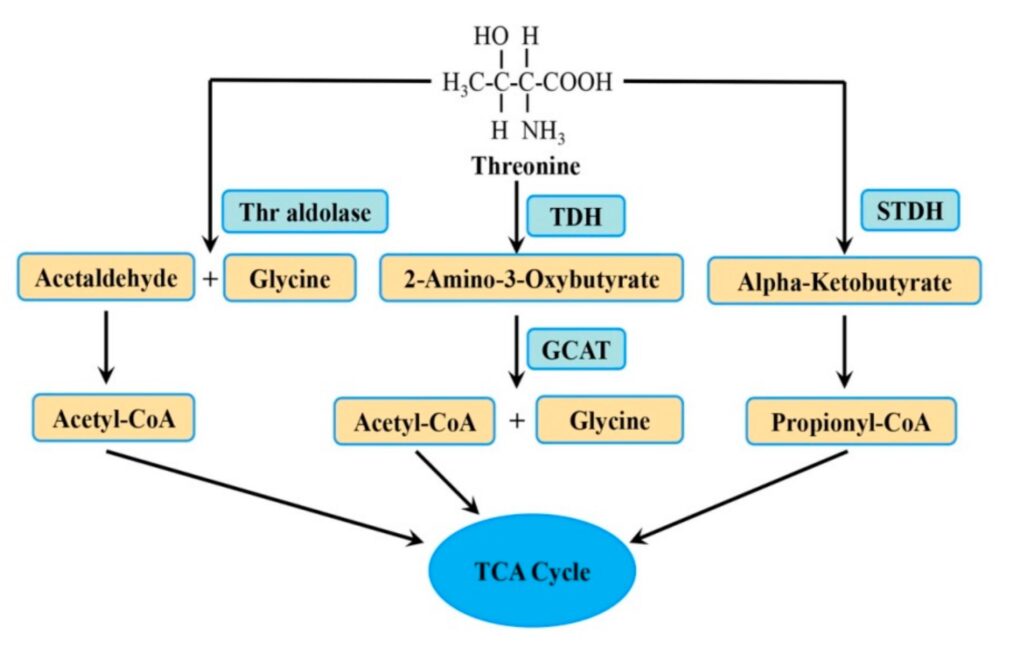
Threonine metabolism is biochemically important because:
- It contributes to both glucogenic and ketogenic pathways.
- It is closely linked with glycine and serine metabolism.
- It participates in mucin synthesis and intestinal protection.
- It provides intermediates for energy production.
Threonine metabolism mainly occurs in:
- Liver
- Kidney
- Pancreas
- Intestinal mucosa
Chemical Structure and Properties
| Property | Description |
|---|---|
| Chemical Formula | C₄H₉NO₃ |
| Molecular Weight | 119 Da |
| Type | Essential amino acid |
| Nature | Polar, uncharged |
| Functional Group | Hydroxyl group (-OH) |
| Classification | Glucogenic and ketogenic |
Dietary Sources
Vegetarian Sources
| Food | Threonine Content |
|---|---|
| Soybean | High |
| Lentils | Moderate |
| Nuts | Moderate |
| Seeds | Moderate |
| Whole grains | Moderate |
Non-Vegetarian Sources
| Food | Threonine Content |
|---|---|
| Eggs | High |
| Fish | High |
| Chicken | High |
| Milk | Moderate |
| Meat | High |
Absorption and Transport
- Threonine is absorbed in the small intestine by sodium-dependent amino acid transporters.
- Transported through portal circulation to liver.
- Distributed to tissues for:
- Protein synthesis
- Energy metabolism
- Cellular growth
Metabolism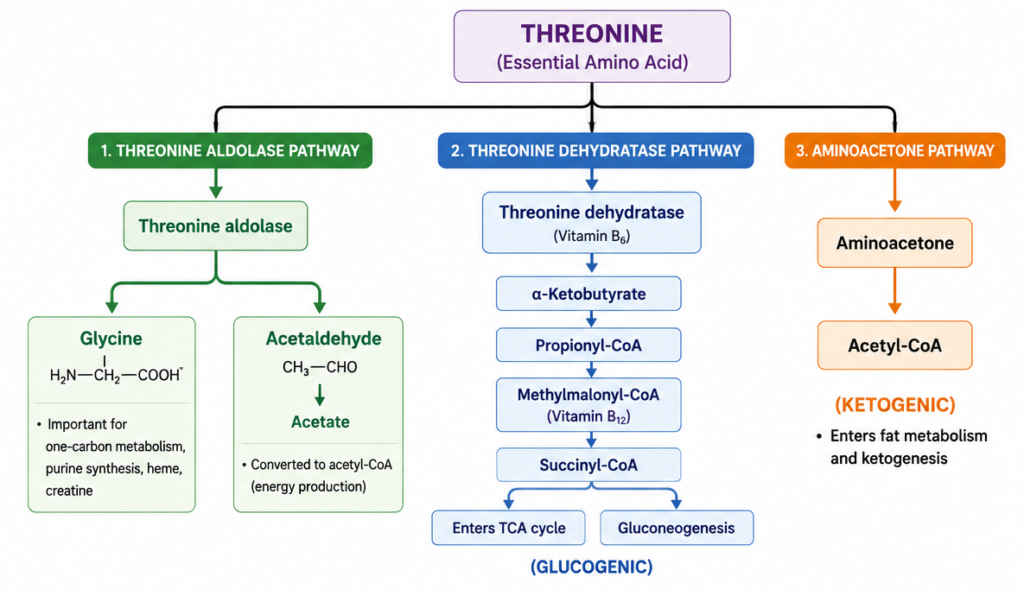
| Pathway | Major Product |
|---|---|
| Threonine aldolase pathway | Glycine + Acetaldehyde |
| Threonine dehydratase pathway | α-Ketobutyrate |
| Aminoacetone pathway | Acetyl-CoA |
| Protein incorporation | Structural proteins |
Catabolism
Threonine degradation mainly occurs in mitochondria of liver cells.
1. Threonine Aldolase Pathway
This pathway converts threonine into glycine and acetaldehyde.
Reaction
Threonine → Glycine + Acetaldehyde
Enzyme
Threonine Aldolase
- Pyridoxal phosphate dependent enzyme
- Present mainly in liver
Fate of Products
| Product | Fate |
|---|---|
| Glycine | Purine synthesis, one-carbon metabolism |
| Acetaldehyde | Converted to acetate and acetyl-CoA |
Significance
- Connects threonine with glycine metabolism
- Supports nucleotide synthesis
- Important in folate-dependent reactions
2. Threonine Dehydratase Pathway
This is a major catabolic pathway.
Reaction
Threonine → α-Ketobutyrate + NH3
Enzyme
Threonine Dehydratase
Cofactor
- Pyridoxal phosphate (Vitamin B₆)
Conversion of α-Ketobutyrate
α-Ketobutyrate undergoes oxidative decarboxylation.
Pathway
α-Ketobutyrate → Propionyl-CoA → Methylmalonyl-CoA → Succinyl-CoA
Important Cofactors
| Cofactor | Function |
|---|---|
| Biotin | Carboxylation |
| Vitamin B₁₂ | Methylmalonyl-CoA mutase |
| NAD⁺ | Oxidation reactions |
Importance of Succinyl-CoA Formation
Succinyl-CoA enters:
- TCA cycle
- Gluconeogenesis
- ATP production
Thus, threonine acts as a glucogenic amino acid.
3. Aminoacetone Pathway
Threonine may also be converted into aminoacetone.
Importance
Aminoacetone forms:
- Pyruvate
- Acetyl-CoA
This pathway contributes to:
- Ketogenesis
- Energy production
Why Threonine is Both Glucogenic and Ketogenic
| Pathway | Product | Type |
|---|---|---|
| Succinyl-CoA formation | Glucose precursor | Glucogenic |
| Acetyl-CoA formation | Ketone body precursor | Ketogenic |
Functions of Threonine
Threonine is incorporated into:
- Structural proteins
- Enzymes
- Collagen
- Elastin
It contributes to:
- Tissue growth
- Repair
- Protein stability
2. Mucin Synthesis
Threonine is highly abundant in mucin glycoproteins.
Importance of Mucin
- Protects gastrointestinal mucosa
- Prevents acid injury
- Maintains intestinal barrier
Deficiency may impair gut health.
3. Immune Function
Threonine is essential for synthesis of:
- Immunoglobulins
- Acute phase proteins
- Cytokines
It supports:
- Immune response
- Infection resistance
4. Glycine Formation
Threonine contributes to glycine synthesis.
Importance of Glycine
- Purine synthesis
- Heme synthesis
- Creatine formation
5. Energy Production
Threonine contributes intermediates to:
- TCA cycle
- ATP production
- Glucose synthesis
6. Nervous System Function
Through glycine production, threonine indirectly supports:
- Neurotransmission
- Myelin synthesis
- Brain function
Specialized Products Derived from Threonine
| Product | Biological Importance |
|---|---|
| Glycine | One-carbon metabolism |
| Acetyl-CoA | Fat metabolism |
| Succinyl-CoA | TCA cycle |
| ATP | Energy production |
Regulation
| Factor | Role |
|---|---|
| Vitamin B₆ | Cofactor for threonine dehydratase |
| Vitamin B₁₂ | Required for succinyl-CoA formation |
| Liver function | Main metabolic site |
| Nutritional state | Regulates catabolism |
Clinical Significance
Causes
- Malnutrition
- Low protein diet
- Malabsorption syndrome
Symptoms
| Symptom | Mechanism |
|---|---|
| Growth retardation | Reduced protein synthesis |
| Fatty liver | Disturbed lipid metabolism |
| Weak immunity | Reduced antibody synthesis |
| Digestive disturbances | Reduced mucin formation |
2. Vitamin B₆ Deficiency
Vitamin B₆ deficiency impairs:
- Threonine dehydratase activity
- Amino acid catabolism
Result:
- Amino acid imbalance
- Reduced energy production
3. Vitamin B₁₂ Deficiency
Impaired conversion of methylmalonyl-CoA to succinyl-CoA leads to:
- Methylmalonic acid accumulation
- Neurological manifestations
4. Liver Disease
Since liver is the major site of metabolism:
- Threonine degradation decreases
- Plasma amino acid imbalance develops
5. Inherited Metabolic Disorders
Rare enzyme defects may cause:
- Metabolic acidosis
- Developmental delay
- Neurological abnormalities
Relationship Between Glycine, Serine and Threonine
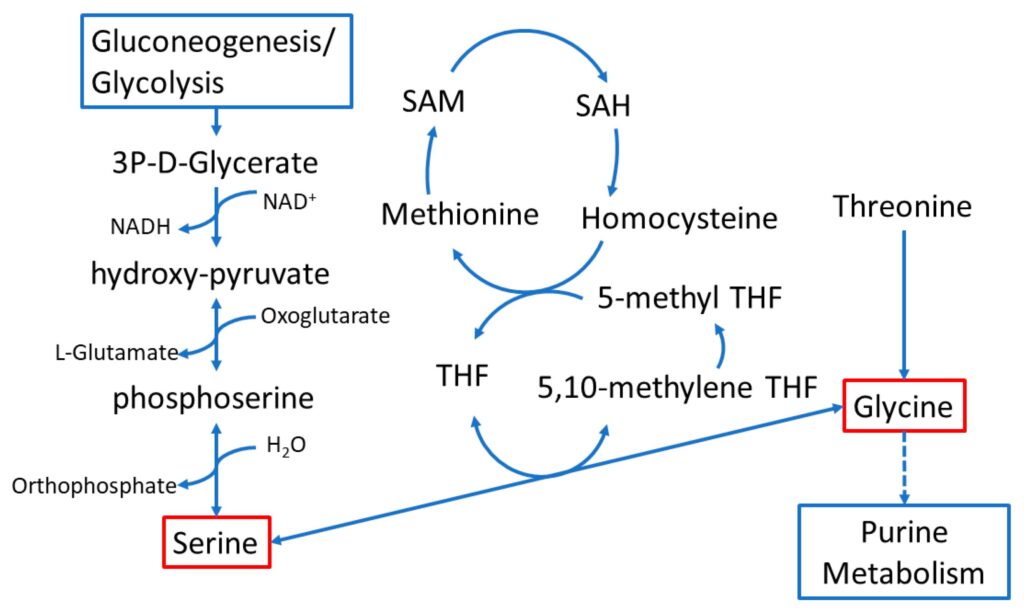
| Amino Acid | Relationship |
|---|---|
| Threonine → Glycine | Threonine aldolase pathway |
| Serine ↔ Glycine | THF dependent |
| Glycine → Purines | DNA synthesis |
| Threonine → Succinyl-CoA | Energy metabolism |
Laboratory Investigation
| Test | Purpose |
|---|---|
| Plasma amino acid profile | Amino acid imbalance |
| Urinary organic acids | Metabolic defects |
| Vitamin B₁₂ level | Succinyl-CoA pathway assessment |
| Liver function tests | Metabolic status |