Introduction
- Cells require nutrients, water, oxygen, and other essential substances to survive and perform their functions.
- Cells remove waste products, such as carbon dioxide and metabolic wastes, to maintain normal cellular activity.
- Cell transport is the movement of substances across the plasma membrane into or out of a cell.
- The plasma membrane is selectively permeable, allowing certain substances to pass through more easily than others.
- Cell transport helps maintain cellular homeostasis and regulate water and electrolyte balance.
- It facilitates the movement of essential nutrients and gases while helping remove unwanted substances.
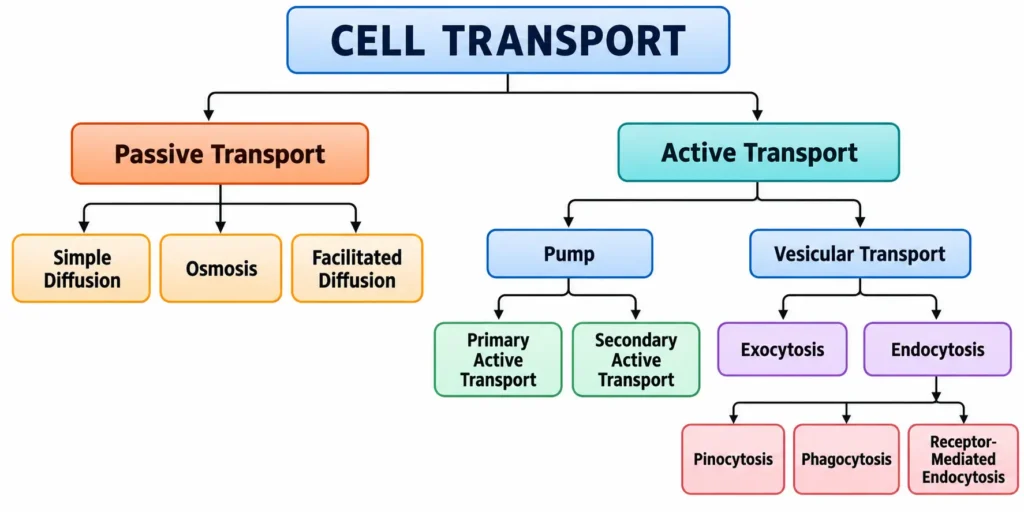
- Cell transport occurs through three major mechanisms:
- Passive transport
- Active transport
- Vesicular transport
- These transport mechanisms are essential for maintaining normal cellular function and survival.
What Is Cell Transport?
Cell transport is the movement of molecules, ions, and other substances across the plasma membrane through specific transport mechanisms.
The plasma membrane is selectively permeable, meaning that it allows certain substances to pass through more easily than others.
For example:
- Oxygen enters cells by simple diffusion.
- Glucose enters many cells through facilitated diffusion or active transport, depending on the tissue and transporter.
- Water moves across the membrane through osmosis.
- Sodium and potassium ions are transported by the sodium-potassium pump.
- Large particles enter cells through endocytosis.
These transport mechanisms enable cells to maintain their internal environment and carry out essential biochemical reactions.
Types of Cell Transport
Cell transport is broadly classified into three major types:
Passive Transport
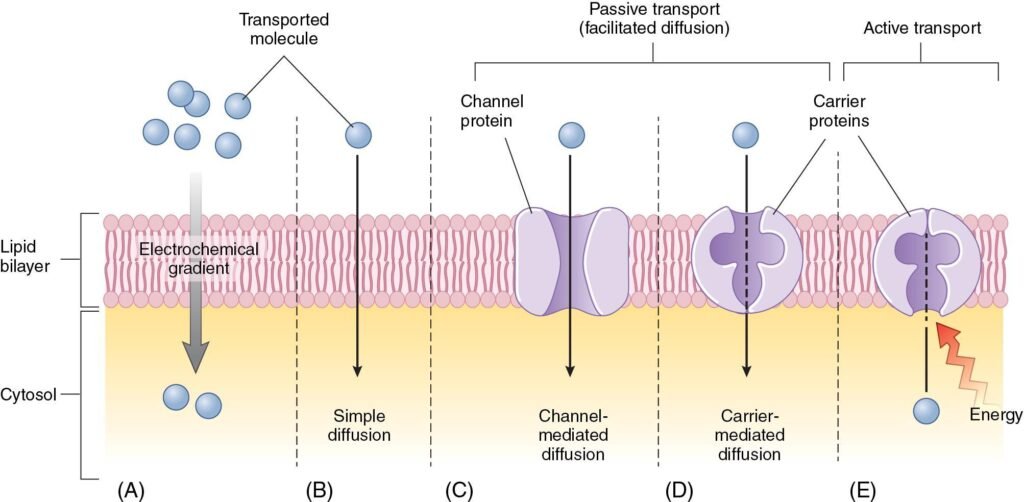
- Passive transport is an essential process that allows substances to move across the plasma membrane without requiring direct energy expenditure by the cell in the form of ATP.
- It helps cells obtain essential substances, remove waste products, and maintain cellular homeostasis.
- Passive transport is the movement of molecules or ions across a selectively permeable cell membrane down their concentration or electrochemical gradients without direct expenditure of cellular energy.
Types of Passive Transport
Passive transport is classified into three major types:
A. Simple Diffusion
- Simple diffusion is the movement of molecules from a region of higher concentration to a region of lower concentration directly through the lipid bilayer or through certain membrane channels.
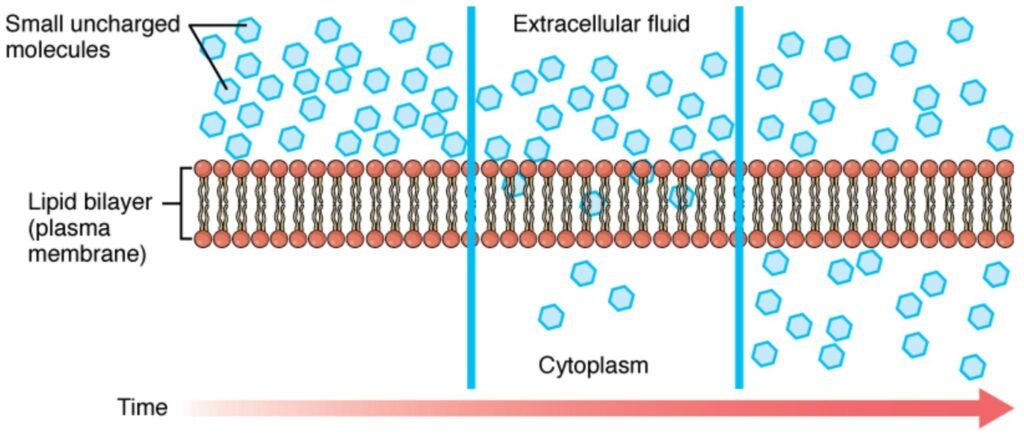
Examples:
- Oxygen entering cells.
- Carbon dioxide leaving cells.
- Movement of lipid-soluble substances across the plasma membrane.
Features:
- Does not require direct ATP expenditure.
- Occurs down the concentration gradient.
- Does not require a carrier protein when molecules cross the lipid bilayer directly.
- Depends on the concentration gradient and membrane permeability.
B. Osmosis
- Osmosis is the net movement of water across a selectively permeable membrane in response to differences in water potential.
- Water moves toward the side with the higher effective concentration of non-penetrating solutes.
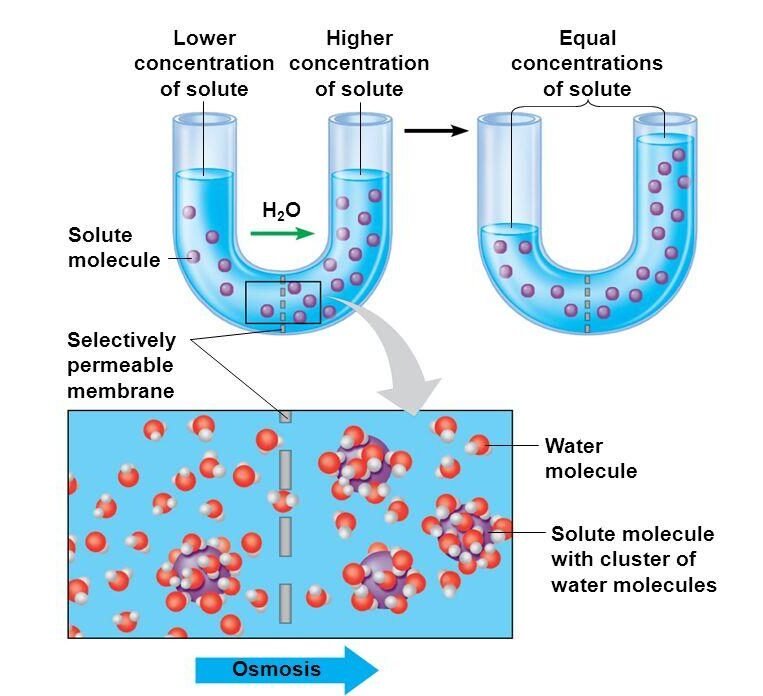
Examples:
- Water movement across kidney tubules.
- Water absorption in the intestine.
- Changes in red blood cell volume in solutions of different tonicities.
Types of Solutions Based on Tonicity:
- Isotonic solution: The cell maintains approximately the same volume.
- Hypotonic solution: Water enters the cell, causing it to swell.
- Hypertonic solution: Water leaves the cell, causing it to shrink.
C. Facilitated Diffusion
- Facilitated diffusion is the movement of substances across the plasma membrane with the help of specific membrane proteins, without direct ATP expenditure.
- It occurs down the concentration or electrochemical gradient.
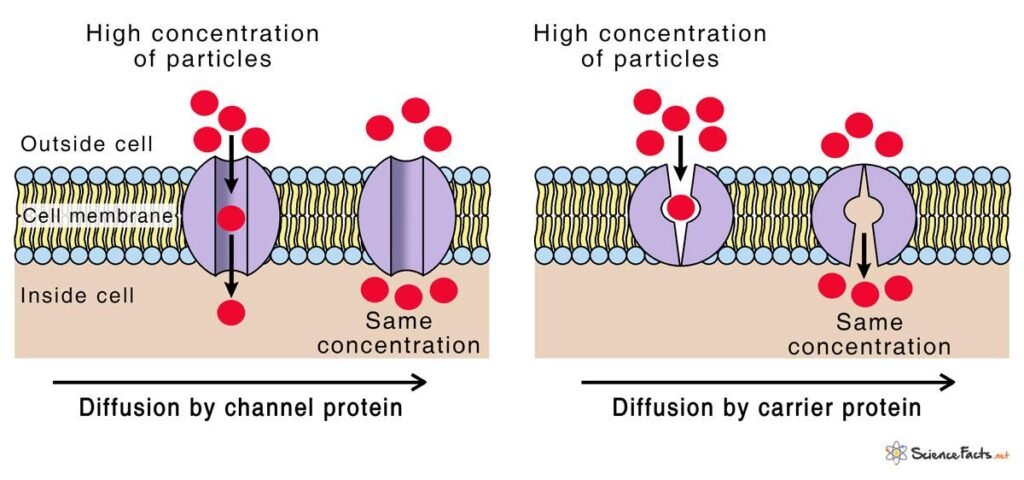
Types of Membrane Proteins Involved:
- Channel proteins: Form pathways for specific ions or molecules to cross the membrane.
- Carrier proteins: Bind specific substances and change their shape to transport them across the membrane.
Examples:
- Glucose transport through GLUT transporters.
- Potassium movement through potassium channels.
- Chloride movement through chloride channels.
Features:
- Does not require direct ATP expenditure.
- Requires specific membrane transport proteins.
- Shows selectivity for particular substances.
- Carrier-mediated transport can become saturated.
Characteristics of Passive Transport
- Does not require direct cellular energy expenditure in the form of ATP.
- Usually moves substances down their concentration or electrochemical gradients.
- Helps maintain cellular homeostasis.
- May occur directly through the lipid bilayer or through membrane proteins.
- The rate of transport depends on factors such as the concentration gradient and membrane permeability.
- Facilitated diffusion is selective and can become saturated.
Difference Between Simple Diffusion and Facilitated Diffusion
| Feature | Simple Diffusion | Facilitated Diffusion |
|---|---|---|
| Transport proteins | Not required for direct passage through the lipid bilayer | Required |
| Energy | No direct ATP expenditure | No direct ATP expenditure |
| Specificity | Depends on membrane permeability | High specificity for transported substances |
| Saturation | No carrier saturation | Carrier-mediated transport can become saturated |
| Example | Oxygen crossing the membrane | Glucose transport through GLUT |
Clinical Significance of Passive Transport
Passive transport is important in several physiological and clinical processes.
- Gas Exchange: Oxygen and carbon dioxide move by diffusion during respiration.
- Kidney Function: Water movement contributes to urine concentration and fluid balance.
- Intestinal Absorption: Water moves across the intestinal epithelium by osmosis.
- Glucose Transport: GLUT transporters facilitate glucose movement across cell membranes.
- Electrolyte Balance: Ion channels help regulate membrane potential and cellular electrical activity.
Active Transport
- Active transport is the movement of substances across the cell membrane against their concentration or electrochemical gradients.
- It requires an energy source and specific transport proteins.
- Active transport is essential for maintaining ion gradients, nutrient absorption, and normal cellular function.
Types of Active Transport
Active transport is classified into two major types:
- Primary active transport
- Secondary active transport
A. Primary Active Transport
- Primary active transport is the movement of substances across the cell membrane against their concentration or electrochemical gradients using energy directly obtained from ATP hydrolysis.
Mechanism:
- A specific substance binds to a membrane transport protein.
- ATP provides energy through hydrolysis.
- The transport protein undergoes a conformational change.
- The substance moves across the membrane against its gradient.
- The transport protein returns to its original state.
Examples of Primary Active Transport:
1. Sodium-Potassium Pump (Na⁺/K⁺-ATPase)
The sodium-potassium pump is an important membrane protein found in animal cells. It maintains sodium and potassium concentration gradients across the plasma membrane.
Mechanism:
- Three sodium ions (Na⁺) are transported out of the cell.
- Two potassium ions (K⁺) are transported into the cell.
- One ATP molecule is hydrolyzed during each transport cycle.
Functions:
- Maintains sodium and potassium concentration gradients.
- Helps maintain the resting membrane potential.
- Supports normal nerve and muscle function.
- Contributes to cell volume regulation.
- Provides the sodium gradient required for secondary active transport.
2. Calcium Pump (Ca²⁺-ATPase)
Calcium pumps transport calcium ions against their electrochemical gradients using energy from ATP hydrolysis.
Functions:
- Maintains low cytosolic calcium concentrations.
- Helps regulate muscle contraction and relaxation.
- Supports intracellular signaling.
- Participates in calcium storage within the endoplasmic and sarcoplasmic reticulum.
3. Proton Pump (H⁺-ATPase)
Proton pumps transport hydrogen ions across membranes using energy from ATP hydrolysis.
Functions:
- Helps regulate intracellular and organelle pH.
- Contributes to acid secretion in gastric parietal cells.
- Supports the acidification of intracellular compartments.
B. Secondary Active Transport
- Secondary active transport is the movement of a substance against its concentration or electrochemical gradient using energy stored in the gradient of another substance.
- Unlike primary active transport, the transporter does not directly hydrolyze ATP.
- Instead, it uses an ion gradient, commonly the sodium gradient, established by primary active transport.
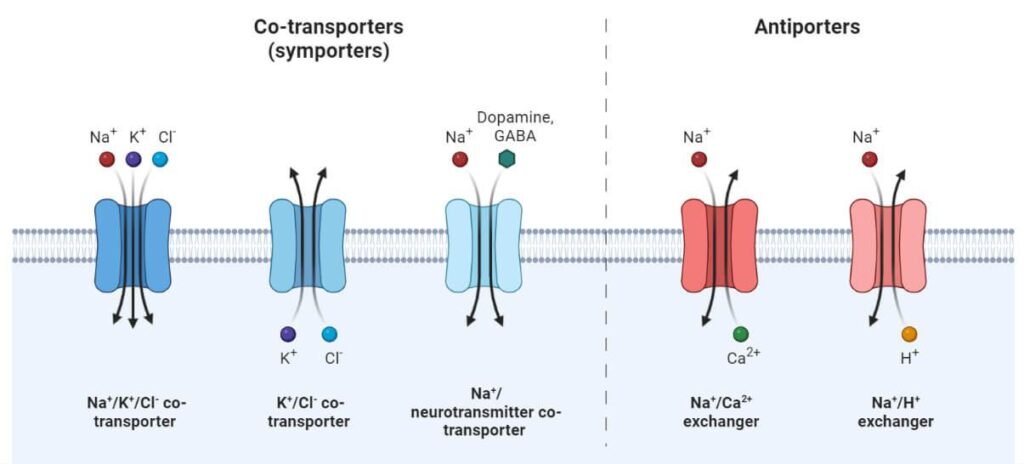
Mechanism:
- Primary active transport establishes an ion gradient across the membrane.
- The ion moves down its electrochemical gradient through a secondary transporter.
- The energy released drives another substance against its gradient.
- Both substances move across the membrane through the same transport protein.
Secondary active transport is classified into two types:
1. Symport (Co-transport)
- Symport is a transport mechanism in which two or more substances move across the membrane in the same direction.
Example: Sodium-Glucose Co-transporter (SGLT)
- Sodium-glucose co-transport uses the inward sodium gradient to transport glucose into cells.
Functions and examples:
- SGLT1 helps absorb glucose in the small intestine.
- SGLT2 contributes to glucose reabsorption in the kidneys.
- Sodium movement down its electrochemical gradient provides the energy for glucose transport against its gradient.
2. Antiport (Counter-transport)
- Antiport is a transport mechanism in which two substances move across the membrane in opposite directions.
Examples:
A. Sodium-Calcium Exchanger (NCX)
- Usually moves sodium ions into the cell while transporting calcium ions out.
- Helps regulate intracellular calcium concentration.
- Plays an important role in cardiac muscle function.
B. Sodium-Hydrogen Exchanger (NHE)
- Exchanges sodium ions entering the cell for hydrogen ions leaving the cell.
- Helps regulate intracellular pH.
- Contributes to sodium and fluid absorption in certain tissues.
Characteristics of Active Transport
- Requires an energy source.
- Uses specific membrane transport proteins.
- Can move substances against their concentration or electrochemical gradients.
- Helps maintain ion gradients across the plasma membrane.
- Plays an important role in cellular homeostasis.
- Primary active transport uses energy directly from ATP hydrolysis.
- Secondary active transport uses energy stored in an ion gradient.
Difference Between Primary and Secondary Active Transport
| Feature | Primary Active Transport | Secondary Active Transport |
|---|---|---|
| Energy source | Directly uses energy from ATP hydrolysis or another direct energy source | Uses energy stored in an ion gradient |
| Direct ATP hydrolysis by transporter | Yes, in ATP-driven pumps | No |
| Mechanism | Transport protein uses energy directly to move substances | Movement of one substance down its gradient drives another substance against its gradient |
| Types | ATP-driven pumps | Symport and antiport |
| Examples | Na⁺/K⁺-ATPase, Ca²⁺-ATPase | Sodium-glucose co-transporter, sodium-calcium exchanger |
Clinical Significance of Active Transport
Active transport is essential for several physiological processes and has important clinical applications.
A. Nerve and Muscle Function
- The sodium-potassium pump maintains ion gradients necessary for normal electrical activity in nerve and muscle cells.
B. Intestinal Glucose Absorption
- Sodium-glucose co-transport helps absorb glucose from the small intestine.
- This mechanism is also used in oral rehydration therapy to improve sodium and water absorption during diarrheal illness.
C. Kidney Function
- Active transport mechanisms help the kidneys reabsorb glucose and electrolytes and regulate fluid and acid-base balance.
D. Cardiac Muscle Function
- Calcium pumps and sodium-calcium exchangers help regulate intracellular calcium, which is essential for cardiac muscle contraction and relaxation.
E. Gastric Acid Secretion
- The H⁺/K⁺-ATPase proton pump in gastric parietal cells secretes hydrogen ions into the stomach.
- Proton pump inhibitors act on this pump to reduce gastric acid secretion.
Vesicular Transport
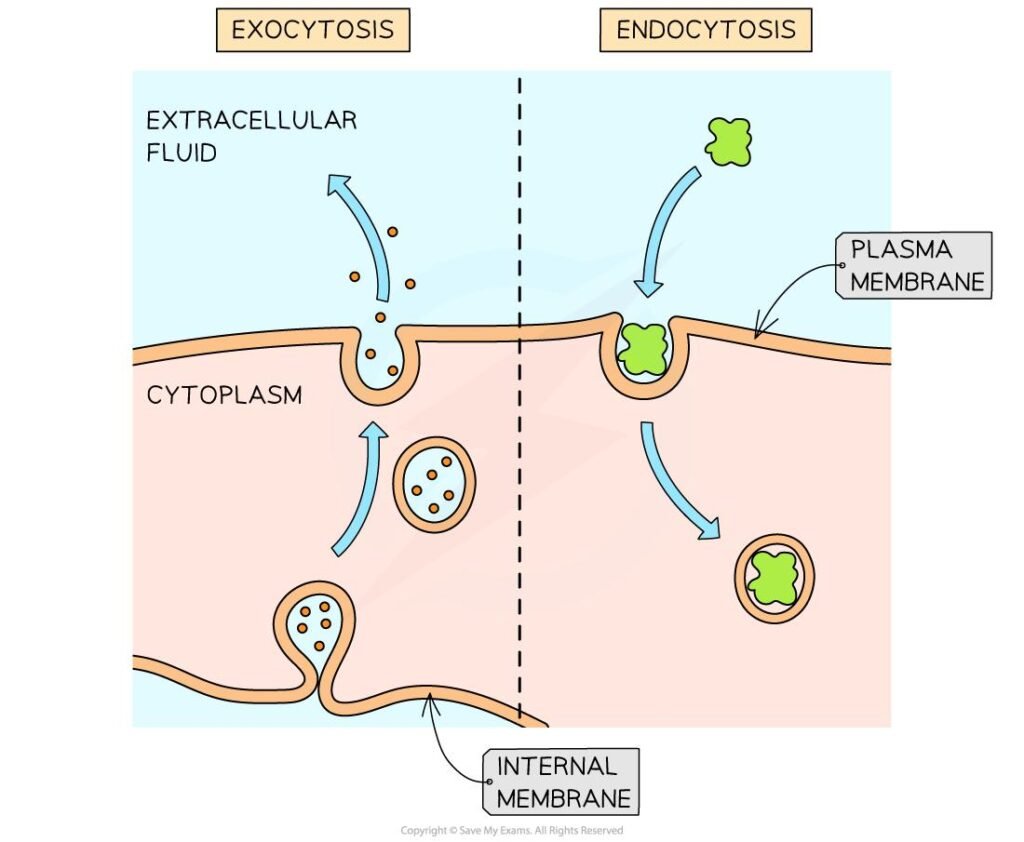
- Vesicular transport is an important cellular process that allows large molecules, particles, and bulk quantities of substances to move into or out of cells through membrane-bound vesicles.
- It involves the formation, movement, and fusion of vesicles with cellular membranes.
- Unlike simple diffusion and facilitated diffusion, vesicular transport involves changes in membrane structure and generally requires cellular energy.
- It plays an essential role in cellular communication, secretion, nutrient uptake, and the removal of unwanted materials.
Types of Vesicular Transport
Vesicular transport across the plasma membrane is classified into two major types:
- Endocytosis
- Exocytosis
A. Endocytosis
- Endocytosis is the process by which a cell takes up substances from the extracellular environment by enclosing them within a portion of the plasma membrane to form intracellular vesicles.
- It enables cells to internalize large particles, extracellular fluids, and specific molecules that cannot readily cross the plasma membrane.
Mechanism:
- The substance approaches or binds to the cell membrane.
- The plasma membrane folds inward around the substance.
- The membrane forms an invagination.
- A vesicle is formed and internalized into the cell.
- The vesicle may fuse with endosomes or lysosomes for sorting or processing.
Types of Endocytosis:
1. Phagocytosis
- Phagocytosis is the process by which a cell engulfs large particles, microorganisms, or cellular debris.
- It is commonly known as cell eating.
Mechanism:
- The cell recognizes and binds to the particle.
- The plasma membrane extends around the particle.
- The membrane encloses the particle to form a phagosome.
- The phagosome may fuse with a lysosome.
- Enzymes within the resulting phagolysosome help digest the engulfed material.
Examples:
- Macrophages engulfing bacteria.
- Neutrophils engulfing microorganisms.
- Phagocytic cells removing dead cells and cellular debris.
Functions:
- Defense against infections.
- Removal of damaged cells.
- Clearance of cellular debris.
- Support of immune responses.
2. Pinocytosis
- Pinocytosis is the process by which a cell takes up extracellular fluid and dissolved substances into small vesicles.
- It is commonly known as cell drinking.
Mechanism:
- The plasma membrane invaginates.
- Extracellular fluid and dissolved substances enter the invagination.
- The membrane encloses the fluid.
- A small vesicle forms and enters the cell.
- The vesicle contents may be transported, sorted, or processed.
Examples:
- Uptake of extracellular fluid by many cell types.
- Internalization of dissolved substances from the extracellular environment.
Functions:
- Uptake of extracellular fluid.
- Internalization of dissolved molecules.
- Membrane recycling and cellular nutrient handling.
3. Receptor-Mediated Endocytosis
- Receptor-mediated endocytosis is a selective process in which specific extracellular substances bind to receptors on the plasma membrane and are internalized into vesicles.
- This mechanism allows cells to take up particular substances efficiently.
Mechanism:
- A specific molecule binds to its receptor on the cell membrane.
- Receptor–ligand complexes gather in specialized membrane regions.
- The membrane invaginates and forms a vesicle.
- The vesicle enters the cell and delivers its contents to intracellular compartments.
- The ligand and receptor may be separated, recycled, or directed toward degradation.
Examples:
- Uptake of low-density lipoprotein (LDL) cholesterol through LDL receptors.
- Uptake of transferrin-bound iron through transferrin receptors.
- Internalization of certain hormones and growth factors through their receptors.
Functions:
- Selective uptake of specific molecules.
- Cholesterol uptake and metabolism.
- Iron uptake.
- Regulation of receptor activity and cellular signaling.
B. Exocytosis
- Exocytosis is the process by which intracellular vesicles fuse with the plasma membrane and release their contents into the extracellular environment.
- It is important for secretion, cellular communication, and the delivery of proteins and lipids to the plasma membrane.
Mechanism:
- Substances are packaged into intracellular vesicles.
- The vesicles move toward the plasma membrane.
- The vesicles dock at the membrane.
- The vesicle membrane fuses with the plasma membrane.
- The vesicle contents are released outside the cell.
Examples:
- Insulin secretion from pancreatic beta cells.
- Neurotransmitter release from nerve terminals.
- Secretion of digestive enzymes by pancreatic acinar cells.
- Release of certain hormones from endocrine cells.
Functions:
- Secretion of hormones.
- Release of neurotransmitters.
- Secretion of digestive enzymes.
- Delivery of proteins and lipids to the plasma membrane.
- Renewal and maintenance of the cell membrane.
Types of Exocytosis:
1. Constitutive Exocytosis
- Constitutive exocytosis occurs continuously in many cells without requiring a specific external trigger.
Functions:
- Delivery of proteins and lipids to the plasma membrane.
- Secretion of certain extracellular proteins.
- Maintenance and renewal of the cell membrane.
2. Regulated Exocytosis
- Regulated exocytosis occurs when a specific signal triggers the release of substances stored in secretory vesicles.
Examples:
- Insulin release in response to increased blood glucose.
- Neurotransmitter release in response to an action potential.
- Secretion of digestive enzymes in response to appropriate physiological signals.
Characteristics of Vesicular Transport
- Involves membrane-bound vesicles.
- Enables the transport of large molecules and particles.
- Involves membrane budding, fusion, or both.
- Generally requires cellular energy.
- Supports cellular secretion and uptake.
- Helps maintain plasma membrane composition.
- Plays an important role in intracellular trafficking and cellular communication.
Difference Between Endocytosis and Exocytosis
| Feature | Endocytosis | Exocytosis |
|---|---|---|
| Definition | Uptake of substances into the cell | Release of substances outside the cell |
| Direction | Extracellular environment to intracellular compartments | Intracellular vesicles to the extracellular environment |
| Membrane process | Plasma membrane invaginates to form vesicles | Vesicles fuse with the plasma membrane |
| Main function | Uptake and internalization | Secretion and release |
| Examples | LDL uptake, phagocytosis | Insulin secretion, neurotransmitter release |
Clinical Significance of Vesicular Transport
Vesicular transport is essential for several physiological processes and is associated with important clinical conditions.
A. Immune Defense
- Phagocytosis enables macrophages and neutrophils to engulf and destroy microorganisms.
- It is an important component of the innate immune response.
B. Cholesterol Metabolism
- Receptor-mediated endocytosis allows cells to take up LDL cholesterol through LDL receptors.
- Defects in LDL receptor function can contribute to familial hypercholesterolemia.
C. Hormone Secretion
- Exocytosis enables pancreatic beta cells to release insulin, helping regulate blood glucose concentrations.
D. Neurotransmission
- Neurons release neurotransmitters through regulated exocytosis.
- This process enables communication between nerve cells and their target cells.
E. Digestive Function
- Pancreatic acinar cells release digestive enzymes through exocytosis, supporting the digestion of carbohydrates, proteins, and lipids.
F. Cellular Membrane Maintenance
- Vesicular transport helps deliver membrane proteins and lipids to the plasma membrane and retrieve selected membrane components for recycling or degradation.
Factors Affecting Cell Transport
Several factors influence the movement of substances across the plasma membrane.
1. Concentration Gradient
- A larger concentration difference generally increases the rate of diffusion, provided other factors remain constant.
2. Temperature
- Increasing temperature generally increases molecular movement and can increase diffusion rates.
3. Molecular Size
- Smaller molecules generally cross the lipid bilayer more easily than larger molecules of similar chemical properties.
4. Lipid Solubility
- Lipid-soluble substances can pass through the membrane’s lipid bilayer more readily than many polar substances.
5. Membrane Surface Area
- A larger available membrane surface area can increase the total rate of transport.
6. Membrane Thickness
- A thinner membrane generally permits faster diffusion than a thicker membrane, all else being equal.
7. Transport Proteins
- The availability, specificity, and activity of channels and carrier proteins influence the transport of ions and other substances.
8. Electrochemical Gradient
- For ions, transport depends on both the concentration difference and the electrical potential across the membrane.
Clinical Significance of Cell Transport
Cell transport is essential for normal human physiology. Abnormalities in transport proteins or membrane transport mechanisms can contribute to several diseases.
A. Cystic Fibrosis
- Transport mechanism: Facilitated transport through the CFTR chloride and bicarbonate channel.
- Cause: Mutations in the CFTR gene impair the function of the CFTR protein.
- Effect: Abnormal ion transport alters the properties of secretions, particularly in the respiratory and digestive systems.
- Clinical significance: Patients may develop recurrent respiratory infections, thick mucus, and pancreatic insufficiency.
B. Oral Rehydration Therapy (ORT)
- Transport mechanism: Secondary active transport.
- Mechanism: Sodium-glucose co-transport (SGLT1) facilitates the absorption of sodium and glucose from the intestine.
- Effect: Water absorption increases through osmotic mechanisms.
- Clinical significance: Oral rehydration solution (ORS) helps prevent and treat dehydration caused by diarrhea.
C. Familial Hypercholesterolemia
- Transport mechanism: Receptor-mediated endocytosis.
- Cause: Genetic defects affecting LDL receptors or related pathways can reduce LDL clearance from the bloodstream.
- Effect: LDL cholesterol concentrations become markedly elevated.
- Clinical significance: Increases the risk of premature atherosclerosis and cardiovascular disease.
D. Diabetes Mellitus
- Transport mechanism: Facilitated diffusion of glucose through GLUT transporters.
- Mechanism: Insulin stimulates the translocation of GLUT4 transporters to the plasma membrane in skeletal muscle and adipose tissue.
- Effect: Insulin deficiency or resistance reduces insulin-stimulated glucose uptake in these tissues.
- Clinical significance: Contributes to elevated blood glucose levels in diabetes mellitus.
Important point: Glucose transport occurs through different mechanisms in different tissues. For example, GLUT1 and GLUT3 support glucose uptake in many insulin-independent tissues.
E. Kidney Function
- Transport mechanisms: Active transport, secondary active transport, facilitated diffusion, and osmosis.
- Mechanism: Kidney tubules reabsorb glucose, amino acids, electrolytes, and water through specialized transport systems.
- Effect: Maintains fluid balance, electrolyte concentrations, and acid-base homeostasis.
- Clinical significance: Transport abnormalities may contribute to renal tubular disorders, electrolyte disturbances, and abnormal glucose loss in urine.
F. Nerve Impulse Transmission
- Transport mechanism: Active transport and ion-channel-mediated transport.
- Mechanism: The sodium-potassium pump maintains sodium and potassium gradients, while voltage-gated ion channels generate and propagate action potentials.
- Effect: Supports electrical signaling in nerve cells.
- Clinical significance: Abnormalities in ion gradients or channels can impair nerve transmission and contribute to neurological disorders.
G. Muscle Contraction and Relaxation
- Transport mechanism: Active transport of calcium ions.
- Mechanism: Calcium pumps, including SERCA, transport calcium into the sarcoplasmic reticulum during muscle relaxation.
- Effect: Regulates intracellular calcium concentrations.
- Clinical significance: Proper calcium transport is essential for normal skeletal, smooth, and cardiac muscle function.
H. Gastric Acid Secretion
- Transport mechanism: Primary active transport.
- Mechanism: The H⁺/K⁺-ATPase pump in gastric parietal cells transports hydrogen ions into the stomach in exchange for potassium ions.
- Effect: Produces the acidic environment required for normal gastric function.
- Clinical significance: Proton pump inhibitors, such as omeprazole, inhibit this pump and reduce gastric acid secretion.
I. Immune Defense
- Transport mechanism: Vesicular transport through phagocytosis.
- Mechanism: Macrophages and neutrophils engulf microorganisms and cellular debris into vesicles.
- Effect: The engulfed material is processed and may be destroyed following fusion with lysosomes.
- Clinical significance: Phagocytosis is an important component of innate immunity and helps protect the body against infections.
J. Hormone Secretion
- Transport mechanism: Vesicular transport through exocytosis.
- Mechanism: Secretory vesicles fuse with the plasma membrane and release hormones into the extracellular environment.
- Examples: Insulin secretion by pancreatic beta cells and the release of certain hormones from endocrine cells.
- Clinical significance: Defects in hormone synthesis, vesicle transport, or secretion can contribute to endocrine disorders.
K. Water Balance and Osmotic Regulation
- Transport mechanism: Osmosis.
- Mechanism: Water moves across selectively permeable membranes in response to differences in water potential and effective solute concentration.
- Effect: Helps maintain cell volume and body fluid balance.
- Clinical significance: Abnormalities in extracellular fluid tonicity can cause cells to swell or shrink. Severe changes in plasma osmolality may affect brain function.
L. Drug Absorption and Transport
- Transport mechanisms: Simple diffusion, carrier-mediated transport, active transport, and vesicular transport.
- Mechanism: Drugs cross biological membranes through different pathways depending on their chemical properties and the transport proteins present.
- Effect: Influences drug absorption, distribution, and elimination.
- Clinical significance:Transport proteins can affect drug bioavailability, tissue penetration, and treatment response.