Introduction
- RNA stands for Ribonucleic Acid. It is an important nucleic acid found in all living cells.
- It plays an essential role in carrying genetic information and helping in the synthesis of proteins.
- RNA is mainly involved in the transfer of genetic information from DNA to ribosomes, where proteins are produced.
- It also helps regulate gene expression and performs several other important cellular functions.
- RNA is generally single-stranded, unlike DNA, which is usually double-stranded.
Important Characteristics of RNA
- RNA is a nucleic acid made up of repeating units called nucleotides.
- It is usually present as a single-stranded molecule.
- It contains ribose sugar.
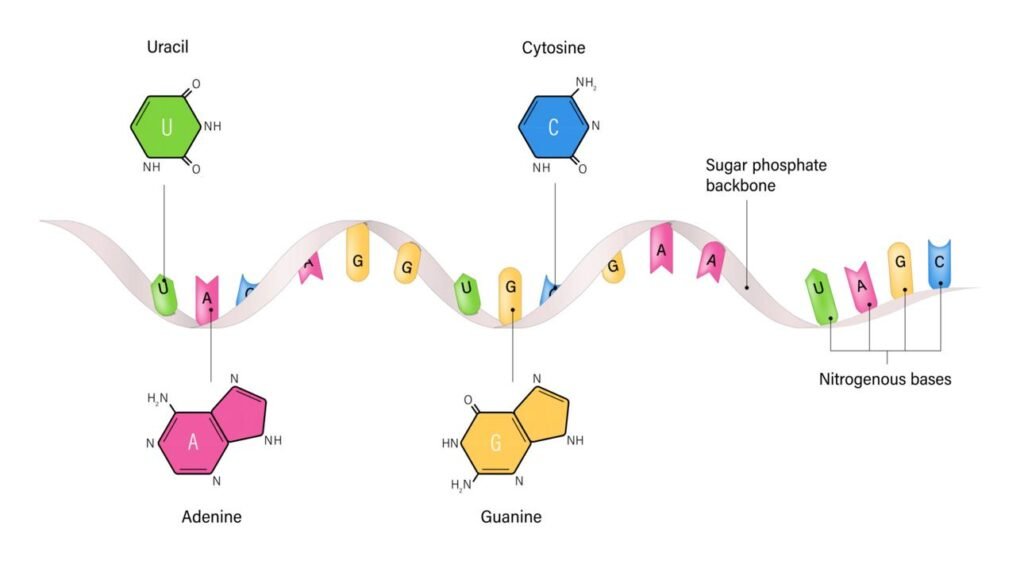
- It contains four nitrogenous bases: Adenine, Guanine, Cytosine and Uracil.
- Uracil is present in RNA instead of Thymine.
- It is found in both the nucleus and cytoplasm of cells.
- It plays an important role in protein synthesis.
- Some RNA molecules also help regulate gene expression.
Structure of RNA
- RNA is a polymer made up of smaller units called nucleotides. These nucleotides are joined together to form a long chain.
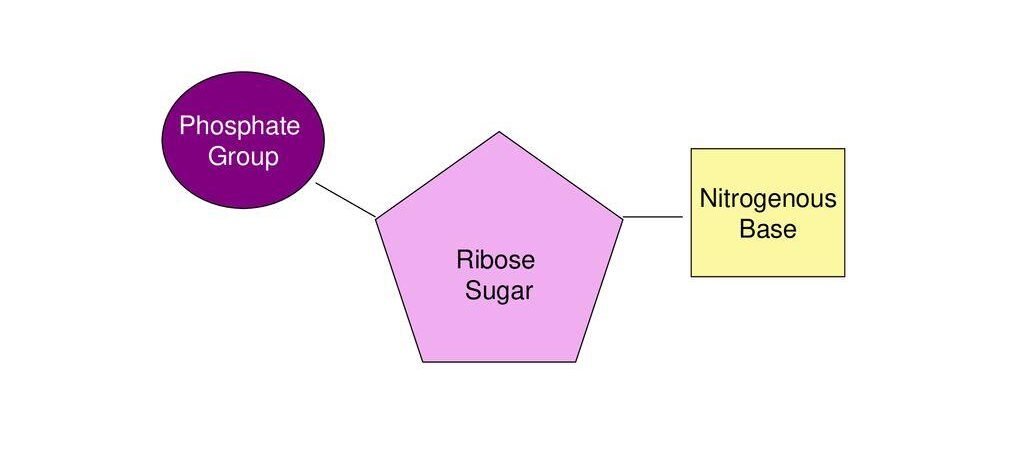
Each RNA nucleotide consists of three basic components:
- Pentose sugar (Ribose)
- Nitrogenous base
- Phosphate group
A. Pentose Sugar (Ribose)
- RNA contains a five-carbon sugar called ribose.
- Ribose is a type of pentose sugar.
- It contains a hydroxyl (-OH) group at the 2′ carbon position.
- This hydroxyl group makes RNA more chemically reactive and less stable than DNA.
- The ribose sugar forms part of the backbone of the RNA molecule.
Important: RNA contains ribose sugar, whereas DNA contains deoxyribose sugar.
B. Nitrogenous Bases
- RNA contains four types of nitrogenous bases. These bases are divided into two groups.
1. Purine Bases
Purines have a double-ring structure.
- Adenine (A)
- Guanine (G)
2. Pyrimidine Bases
Pyrimidines have a single-ring structure.
- Cytosine (C)
- Uracil (U)
Important Points About Nitrogenous Bases
- Adenine pairs with Uracil (A–U).
- Guanine pairs with Cytosine (G–C).
- These base pairs help form folded structures in RNA.
- Uracil replaces Thymine, which is found in DNA.
C. Phosphate Group
- Each RNA nucleotide contains a phosphate group.
- The phosphate group connects the sugar of one nucleotide to the sugar of the next nucleotide.
- It forms phosphodiester bonds between adjacent nucleotides.
- These bonds produce the sugar-phosphate backbone of RNA.
- The RNA strand has two ends: 5′ end and 3′ end.
D. Overall Structure of RNA
The RNA molecule has the following structural features:
- It is generally single-stranded.
- Nucleotides are connected through phosphodiester bonds.
- It has a sugar-phosphate backbone.
- Nitrogenous bases are attached to the ribose sugar.
- The RNA strand can fold upon itself due to complementary base pairing.
- This folding produces different shapes, such as hairpin loops and stem-loop structures.
E. Direction of RNA Strand
RNA has two important ends:
- 5′ end: Contains a phosphate group attached to the 5′ carbon of ribose.
- 3′ end: Contains a free hydroxyl (-OH) group at the 3′ carbon of ribose.
RNA is generally synthesized in the 5′ to 3′ direction.
Types of RNA
- RNA is classified into different types according to its structure and function.
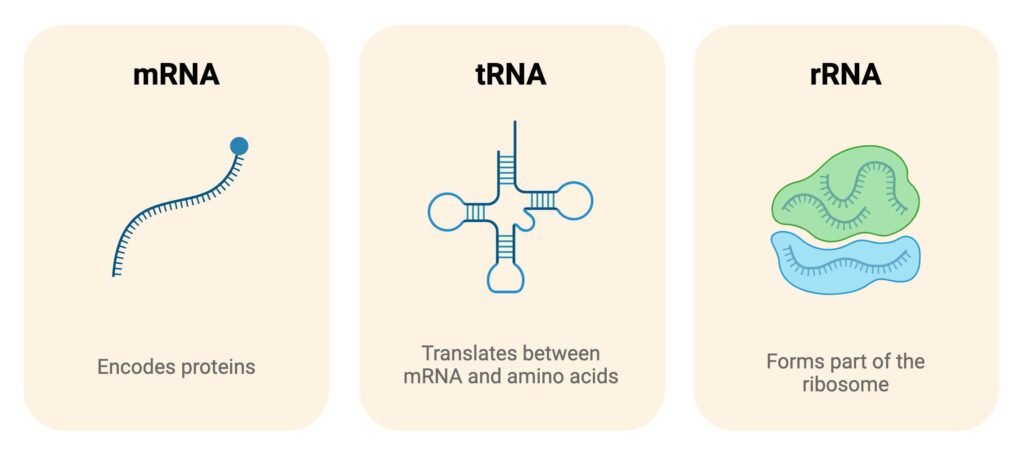
The three major types of RNA involved in protein synthesis are:
- Messenger RNA (mRNA)
- Transfer RNA (tRNA)
- Ribosomal RNA (rRNA)
Other types of RNA mainly perform regulatory and processing functions.
A. Messenger RNA (mRNA)
- Messenger RNA carries genetic information from DNA to ribosomes.
- It provides the instructions required for the formation of proteins.
- It acts as a template during protein synthesis.
Structure of mRNA
- It is generally a single-stranded molecule.
- It contains a sequence of nitrogenous bases.
- The bases are arranged in groups of three called codons.
- Each codon specifies an amino acid or a stop signal.
- In eukaryotic cells, mature mRNA contains a 5′ cap and a 3′ poly-A tail.
Functions of mRNA
- Carries genetic information from DNA to ribosomes.
- Provides the template for protein synthesis.
- Determines the sequence of amino acids in a protein.
- Contains codons that are read during translation.
- Helps control protein production in cells.
Example:
The mRNA produced from the insulin gene carries instructions to ribosomes for the synthesis of insulin protein.
B. Transfer RNA (tRNA)
- Transfer RNA helps transport amino acids to ribosomes during protein synthesis.
- It acts as a carrier molecule that brings the correct amino acids according to the codon sequence present on mRNA.
Structure of tRNA
- It is a small RNA molecule, generally containing approximately 75–90 nucleotides.
- It has a characteristic cloverleaf-shaped secondary structure.
- Its three-dimensional structure is L-shaped.
- It contains an anticodon region.
- It has an amino acid attachment site at its 3′ end.
- It contains some modified bases.
Important Parts of tRNA
1. Acceptor Stem
- It is present at one end of the tRNA molecule.
- It contains the amino acid attachment site.
- Amino acids attach to the 3′ CCA sequence.
2. Anticodon Loop
- It contains three nitrogenous bases called an anticodon.
- The anticodon recognizes the complementary codon on mRNA.
- It helps bring the correct amino acid during protein synthesis.
3. D-Loop
- It contains modified bases, including dihydrouridine.
- It helps in the recognition of tRNA by specific enzymes.
4. TΨC Loop
- It contains the modified base pseudouridine (Ψ).
- It helps tRNA interact with ribosomes.
Functions of tRNA
- Transports specific amino acids to ribosomes.
- Recognizes codons on mRNA through its anticodon.
- Helps arrange amino acids in the correct sequence.
- Participates in the process of protein synthesis.
- Ensures that the correct amino acid is added to the growing protein chain.
Example:
If the mRNA codon is AUG, the complementary tRNA anticodon is UAC. The tRNA carrying methionine recognizes this codon.
C. Ribosomal RNA (rRNA)
- Ribosomal RNA is an important structural and functional component of ribosomes.
- Ribosomes are cellular structures responsible for protein synthesis.
- They consist of rRNA and proteins.
Structure of rRNA
- It is a single-stranded RNA molecule.
- It folds into a complex three-dimensional structure.
- It combines with ribosomal proteins to form ribosomes.
- It is present in both small and large ribosomal subunits.
- In eukaryotic cells, rRNA is mainly synthesized and processed in the nucleolus.
Types of rRNA in Eukaryotic Cells
Eukaryotic ribosomes are 80S and consist of two subunits.
1. Small Subunit (40S)
- Contains 18S rRNA.
- Helps bind mRNA.
- Helps identify and read the codons present on mRNA.
2. Large Subunit (60S)
Contains three types of rRNA:
- 28S rRNA
- 5.8S rRNA
- 5S rRNA
These rRNAs help maintain ribosome structure and participate in peptide bond formation.
Functions of rRNA
- Forms the structural framework of ribosomes.
- Helps bind mRNA and tRNA during protein synthesis.
- Helps position the mRNA and tRNA correctly.
- Catalyses peptide bond formation between amino acids.
- Plays an essential role in the process of translation.
Important: rRNA is not just a structural component. It also performs catalytic functions during protein synthesis.
Other Types of RNA
- Apart from mRNA, tRNA and rRNA, several other RNA molecules perform important functions in cells.
A. Small Nuclear RNA (snRNA)
- Small nuclear RNA is mainly found in the nucleus of eukaryotic cells.
Functions:
- Helps in the processing of pre-mRNA.
- Participates in RNA splicing.
- Helps remove non-coding regions called introns from pre-mRNA.
- Helps join coding regions called exons to form mature mRNA.
Clinical importance: Abnormalities in RNA splicing may contribute to several genetic and other diseases.
B. Small Nucleolar RNA (snoRNA)
- Small nucleolar RNA is mainly found in the nucleolus.
Functions:
- Helps in the processing of ribosomal RNA.
- Guides chemical modifications of rRNA.
- Helps in the proper formation of ribosomes.
C. MicroRNA (miRNA)
- MicroRNA is a small non-coding RNA molecule that regulates gene expression.
- It controls the production of proteins by affecting the activity of specific mRNA molecules.
Functions:
- Binds to complementary sequences in target mRNA.
- Inhibits protein synthesis.
- May promote the degradation of target mRNA.
- Helps regulate cell growth, development and differentiation.
Clinical importance: Changes in miRNA expression are associated with cancer, cardiovascular diseases and metabolic disorders.
D. Small Interfering RNA (siRNA)
- Small interfering RNA is a short double-stranded RNA molecule involved in gene silencing.
Functions:
- Helps control gene expression.
- Recognizes specific mRNA sequences.
- Promotes the degradation of target mRNA.
- Prevents the production of specific proteins.
Clinical importance: siRNA technology is used in research and has applications in developing treatments for certain diseases.
E. Long Non-Coding RNA (lncRNA)
- Long non-coding RNA refers to RNA molecules that are generally longer than 200 nucleotides and do not code for proteins.
Functions:
- Regulates gene expression.
- Influences the activity of DNA and other RNA molecules.
- Participates in cellular development and differentiation.
- Helps regulate various cellular processes.
Clinical importance: Abnormal expression of lncRNA has been associated with cancer and several other diseases.
F. Small Cytoplasmic RNA (scRNA)
- Small cytoplasmic RNA is a group of small RNA molecules present in the cytoplasm.
Functions:
- Participates in the movement and processing of proteins.
- Some scRNAs are involved in directing proteins to specific cellular locations.
- Helps in different cellular activities.
Example: The 7SL RNA is a component of the signal recognition particle (SRP), which helps direct certain newly synthesized proteins towards the endoplasmic reticulum.
Functions of RNA
- RNA performs several important functions in the body.
- Its major role is protein synthesis, but it also regulates gene expression and participates in other cellular activities.
1. Role in Protein Synthesis
RNA plays a central role in protein synthesis through the combined activities of mRNA, tRNA and rRNA.
- mRNA carries genetic instructions from DNA.
- tRNA brings amino acids to ribosomes.
- rRNA forms the ribosome and helps catalyse peptide bond formation.
- Together, these three types of RNA help produce proteins.
2. Transfer of Genetic Information
- mRNA carries genetic information from DNA to ribosomes.
- It contains codons that determine the sequence of amino acids.
- It helps convert genetic instructions into proteins.
3. Transport of Amino Acids
- tRNA transports specific amino acids to ribosomes.
- It recognizes mRNA codons through its anticodon.
- It ensures the correct arrangement of amino acids during protein synthesis.
4. Formation of Ribosomes
- rRNA combines with ribosomal proteins.
- It forms the small and large subunits of ribosomes.
- It provides structural and functional support for protein synthesis.
5. Regulation of Gene Expression
- miRNA and siRNA regulate gene expression.
- They control the activity of specific mRNA molecules.
- They can prevent the production of certain proteins.
- They help maintain normal cellular activities.
6. Processing of RNA
- snRNA helps in the removal of introns from pre-mRNA.
- snoRNA helps in the processing and modification of rRNA.
- These processes help produce functional RNA molecules.
7. Catalytic Activity
Some RNA molecules can act like enzymes. These RNA molecules are called ribozymes.
- They can catalyse specific biochemical reactions.
- They participate in RNA processing.
- They demonstrate that RNA can perform both informational and catalytic functions.
8. Genetic Material in Some Viruses
- Some viruses contain RNA instead of DNA as their genetic material.
- Their RNA carries the information required for viral replication.
- Examples include HIV, influenza virus and SARS-CoV-2.
Process of Protein Synthesis and the Role of RNA
- Protein synthesis is the process by which cells produce proteins using genetic information.
It involves two major steps:
A. Transcription
Transcription is the process of formation of RNA from a DNA template.
Steps:
- RNA polymerase binds to a specific region of DNA called the promoter.
- The DNA strands separate in the transcription region.
- RNA polymerase reads the template DNA strand.
- It adds complementary RNA nucleotides to form an RNA molecule.
- The newly formed RNA molecule is released.
Important: In eukaryotic cells, transcription occurs mainly in the nucleus.
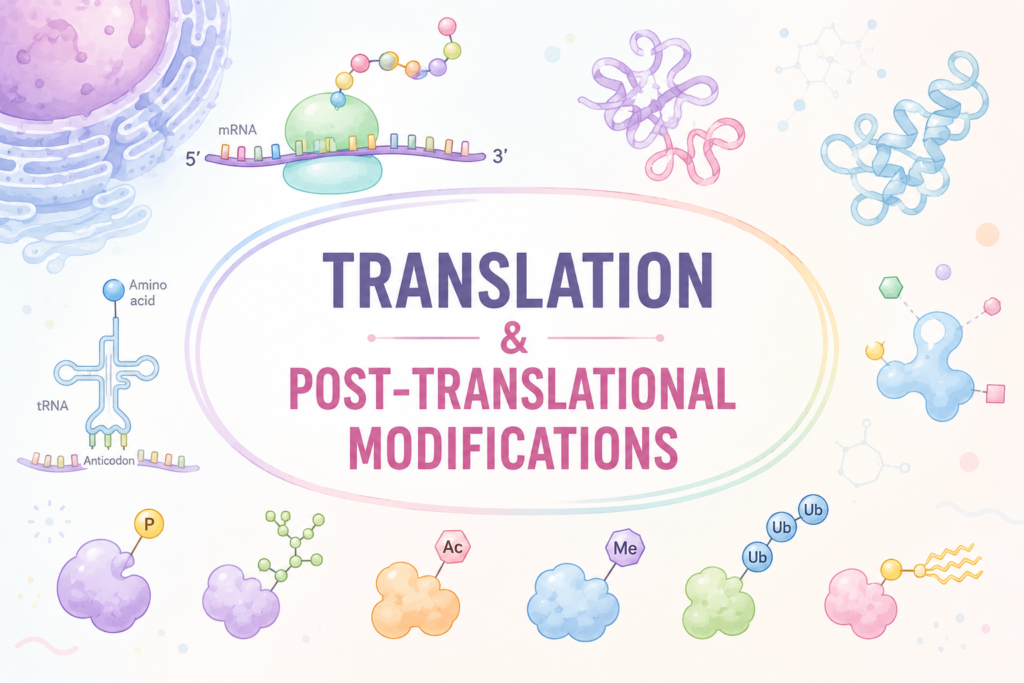
B. Translation
Translation is the process of formation of proteins using the information present in mRNA.
Steps:
- mRNA attaches to the ribosome.
- The ribosome reads the codons present on mRNA.
- tRNA brings the corresponding amino acids.
- Anticodons of tRNA pair with complementary mRNA codons.
- rRNA helps form peptide bonds between amino acids.
- Amino acids join together to form a polypeptide chain.
- The polypeptide chain folds to form a functional protein.
Important: Translation occurs on ribosomes in the cytoplasm or on ribosomes attached to the rough endoplasmic reticulum.